
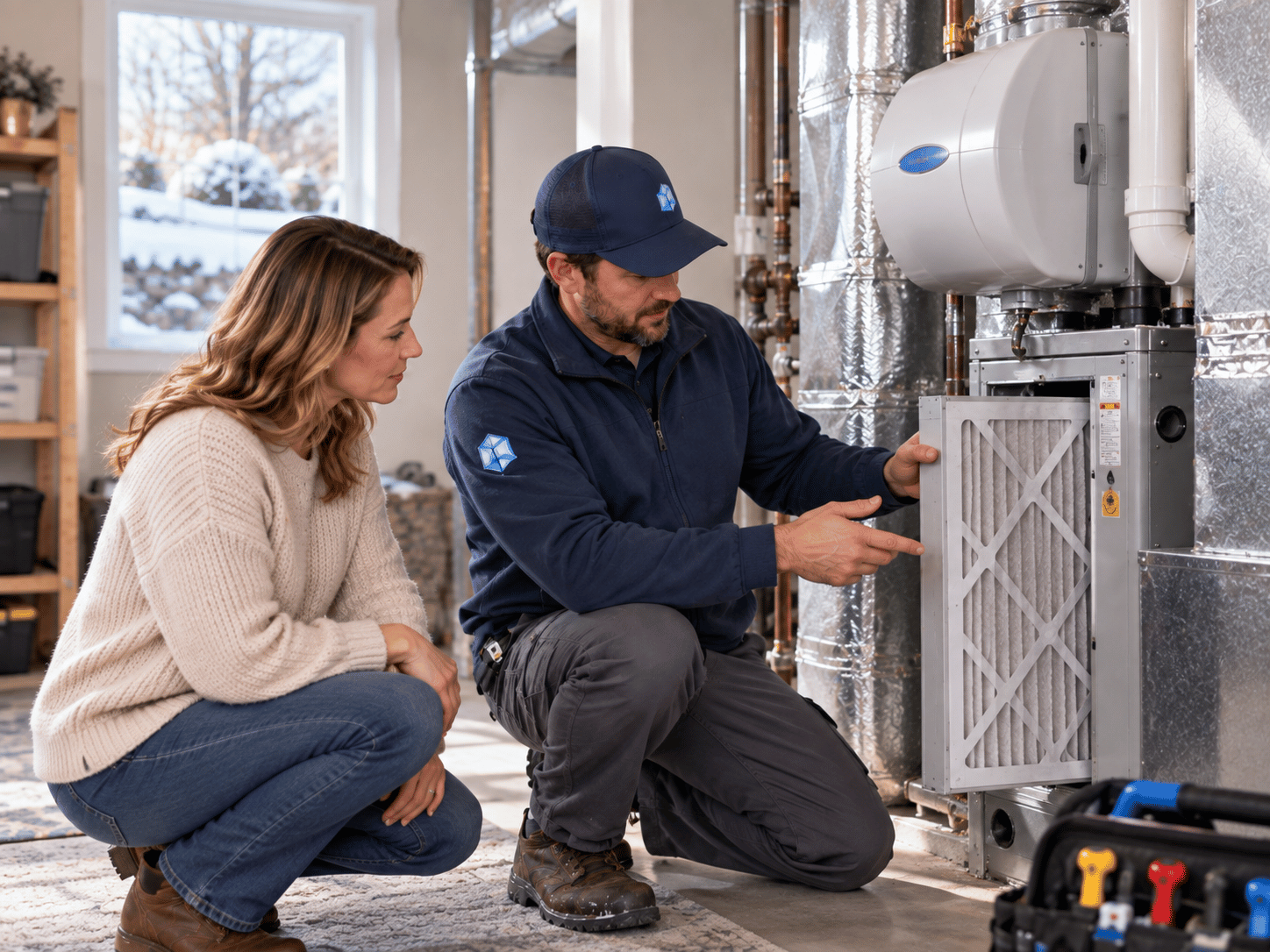
Somewhere around the middle of October, Connecticut homes close up for the season. Windows that were open all summer get shut, storm doors go on, the heat starts running most nights, and for the next five or six months the air inside your house mostly stays inside your house. That is when homeowners start noticing things: static shocks on the stair rail, a cough that will not clear, dust that reappears two days after cleaning, condensation on the bedroom windows every morning.
None of those are coincidences. They are all symptoms of the same underlying shift: a tightly closed house in cold weather behaves very differently from an open house in summer, and the heating system becomes the main thing moving air around.
The scale of this matters more than most people assume. According to the U.S. Environmental Protection Agency's Report on the Environment, "Americans, on average, spend approximately 90 percent of their time indoors," where pollutant concentrations are "often 2 to 5 times higher than typical outdoor concentrations."
This article covers the three things that actually determine winter indoor air quality in a Connecticut home: humidity, filtration, and ventilation. We will tell you what is worth doing, what is worth measuring, and what is mostly marketing. Cool As Ice HVAC has been working in Norwalk and across Fairfield County for more than 30 years, and we would rather you spend money on the one thing that helps your house than on a package of things that do not.
Why Winter Air Is a Different Problem Than Summer Air
In summer, your cooling system is a dehumidifier whether you think of it that way or not. Warm moist air crosses a cold coil, water condenses out, and the house dries. If anything, a well-running system in July pulls out more moisture than you notice.
Winter reverses this. Cold outdoor air holds very little moisture. When that air leaks into your house and gets heated to 70 degrees, its relative humidity drops sharply. A house that felt humid in August can feel like a desert in January without anything changing except the weather.
At the same time, the house is sealed. Cooking, showering, laundry, houseplants, and the simple act of breathing all add moisture indoors, and in winter that moisture has fewer ways out. Depending on how tight your house is, you can end up with either problem: parched air in a leaky old colonial, or trapped moisture and window condensation in a newer, tighter build.
That is why there is no single universal answer. The right move for a 1930s house in Fairfield is often the opposite of the right move for a 2018 house in Ridgefield.
CALL TO ACTION
If your house feels uncomfortable in ways the thermostat cannot fix, we are glad to come look at it. Call Rudy directly at (203) 515-1141 or fill out our contact form to schedule an appointment.
Humidity: The Number Most Connecticut Homes Get Wrong in Winter
Relative humidity is the single most useful indoor air number a homeowner can track, and almost nobody tracks it. A basic digital hygrometer costs very little, and putting one on each floor will usually tell you more about your house than any single service call will.
The EPA's guidance is specific. In A Brief Guide to Mold, Moisture and Your Home, the agency recommends keeping indoor humidity "below 60 percent (ideally between 30 and 50 percent) relative humidity." The EPA gives the same range in its guidance on biological pollutants, where it notes that controlling moisture limits contaminants like mold and dust mites, which are recognized asthma and allergy triggers.
Thirty to fifty percent is a wide band, and that is deliberate. In deep winter, the practical target for most Connecticut homes sits toward the lower end of it, often somewhere around 30 to 40 percent. Push much above that when it is 15 degrees outside and you start getting condensation on cold surfaces, which creates its own problems. For reference, the ENERGY STAR County-Level Design Temperature Reference Guide (2015) lists a 99% heating design temperature of 9°F for Fairfield County, so genuinely cold mornings are part of a normal winter here.
Below 30 percent, things get uncomfortable in familiar ways. Above 50 percent in winter, you are inviting moisture where you do not want it.
Signs Your Home Is Too Dry
- Static electricity every time you touch a doorknob or a light switch.
- Dry, irritated sinuses and throat, especially first thing in the morning.
- Chapped lips and itchy skin that does not improve with lotion.
- Wood floors developing gaps between boards; trim and doors shifting.
- Musical instruments going out of tune more often than usual.
- Furniture joints loosening, or antique pieces showing new cracks.
- A persistent dry cough that seems to be worse indoors than outdoors.
Signs Your Home Is Too Damp in Winter
- Condensation or frost on the inside of window glass in the morning.
- Water droplets on cold exterior walls or around window frames.
- A musty smell in the basement, a closet, or a room over an unheated space.
- Visible mold on window sills, in bathroom corners, or behind furniture on exterior walls.
- Peeling paint or staining on ceilings below bathrooms or attics.
- Clothes in a closet that feel damp to the touch.
Window condensation deserves a note, because it is the most common winter complaint we hear. A little fog at the very bottom edge of a window on the coldest morning of the year is not alarming. Water running down the glass every morning, or ice forming on the inside, means there is more moisture in the house than the building can handle at that temperature.
The EPA's timeline is worth remembering here: "if wet or damp materials or areas are dried 24-48 hours after a leak or spill happens, in most cases mold will not grow." Recurring condensation does not get that 24-to-48-hour window. It re-wets the same surface every night all winter.
Humidifiers: Where They Help and Where They Cause Trouble
If your house reads consistently below 30 percent through the winter, adding moisture is reasonable. Whole-house humidifiers that integrate with a forced-air system can work well, and portable units can handle a single problem room.
But humidifiers are one of the few pieces of home equipment that can actively cause damage when set wrong, so a few things are worth knowing.
- More is not better. The target is a range, not a maximum. A humidifier cranked up in January will put water on your windows and inside your wall cavities.
- The setting has to change with the weather. What is comfortable at 35 degrees outside will cause condensation at 10 degrees outside. Units with an outdoor temperature sensor handle this automatically; manual units need you to turn them down during cold snaps.
- They need maintenance. A humidifier is a wet appliance attached to your heating system. Pads, panels, and reservoirs need regular cleaning or replacement, and a neglected one can become a source of exactly the biological contaminants you were trying to avoid.
- They do not fix a leaky house. If your home is dry because cold outside air is pouring through gaps in the envelope, a humidifier treats the symptom. Air sealing treats the cause and usually helps your heating bill too.
If your home has hydronic heat with radiators or baseboard rather than ducts, a whole-house humidifier tied to an air handler is not an option, and the conversation is different. We work on both kinds of heating systems and can talk through what actually fits your setup.
CALL TO ACTION
Not sure whether your house needs more moisture, less moisture, or better airflow? We will measure it before we recommend anything. Call Rudy directly at (203) 515-1141 or fill out our contact form to schedule an appointment.
Filtration: What a Filter Does and What It Does Not Do
The filter in your furnace or air handler was originally put there to protect the equipment. Keeping dust off the blower wheel and the coil is a real job and a valuable one. Improving the air you breathe is a bonus that a good filter can also deliver.
Here is the important limitation: a central filter only cleans air that passes through it. If your system only runs when the thermostat calls for heat, the filter is only working during those cycles. Many modern thermostats and air handlers allow a continuous or circulating fan mode, which runs the blower at low speed between heating cycles. That single setting change often does more for filtration than upgrading the filter itself.
It also helps with temperature evening-out between floors, which is a common complaint in the two- and three-story colonials all over Darien, New Canaan, and Westport.
Understanding MERV Ratings Without the Marketing
MERV stands for Minimum Efficiency Reporting Value. Higher numbers mean the filter captures a larger fraction of smaller particles.
The EPA's guidance in Guide to Air Cleaners in the Home (2nd edition, 2018) is direct. It advises selecting "a filter with at least a Minimum Efficiency Reporting Value (MERV) 13 rating, or as high a rating as your system fan and filter slot can accommodate." The same guide notes that "filters with a MERV of 13 and above are required to demonstrate at least 50% removal efficiency for the smallest particles tested."
On whether your equipment can handle it, EPA says: "Most furnaces and HVAC systems can accommodate a MERV 13 filter without creating equipment problems, provided that the filter is replaced frequently," and recommends checking with an HVAC technician about your specific system.
That last clause is the part we want to underline, because it is where homeowners get into trouble. A high-MERV filter presents more resistance to airflow than a cheap fiberglass one. In a system with generous duct sizing and a variable-speed blower, that is usually fine. In a system that is already airflow-starved because of undersized returns or a restrictive filter slot, jumping straight to a thick high-MERV filter can reduce airflow enough to cause comfort problems or trip equipment safeties.
The honest answer is that this is checkable. A technician can measure static pressure across your system and tell you what it will tolerate. That takes a few minutes during a normal maintenance visit and is a lot cheaper than guessing wrong in both directions.
A few practical notes:
- Filter thickness matters. A 4-inch or 5-inch media filter at a given MERV generally restricts airflow less than a 1-inch filter at the same rating, because it has far more surface area. If your system has a deep filter cabinet, you have more headroom.
- The filter has to seal. Air takes the easiest path. A filter that fits loosely in its slot lets air bypass around the edges, and then the rating on the box does not mean much.
- Arrows point toward the blower. Installed backwards, a pleated filter loses structure and can collapse.
- A dirty high-MERV filter is worse than a clean lower-MERV one. Restriction climbs as the filter loads.
How Often to Change the Filter
ENERGY STAR's guidance is simple and worth following: check the filter monthly during periods of heavy use, and "if the filter looks dirty after a month, change it. At a minimum, change the filter every 3 months."
In practice, homes with pets, homes with active renovation dust, and homes running the fan continuously go through filters faster. Homes that are empty much of the week go slower. Looking at it monthly takes ten seconds and replaces guesswork with information.
This is not a trivial detail. ENERGY STAR notes that "nearly half of the energy used in your home goes to heating and cooling," so anything that makes that equipment work harder than it needs to shows up on the bill.
Ventilation: The Part Almost Nobody Talks About
Filtration removes particles from air that is already in your house. Ventilation replaces that air with outdoor air. They are different jobs, and a filter cannot do the second one.
The EPA is clear about the hierarchy: "the most effective ways to improve your indoor air are to reduce or remove the sources of pollutants and to ventilate with clean outdoor air." Filtration is a supplement to those two strategies, not a replacement for them.
For residential buildings, the governing technical standard is ANSI/ASHRAE Standard 62.2-2022, Ventilation and Acceptable Indoor Air Quality in Residential Buildings. It applies to single-family houses and multifamily dwellings, both new and existing, and it calls for whole-house mechanical ventilation systems that operate either continuously or intermittently, along with requirements for local exhaust and combustion appliances.
What does that mean for an existing Connecticut home? A few things:
- Bathroom and kitchen exhaust fans are ventilation equipment, not luxuries. They remove moisture and cooking pollutants at the source, which is the most efficient place to remove them. Run the bath fan during and for a while after every shower. Run the range hood when you cook, and make sure it actually vents outdoors rather than recirculating.
- Older leaky homes get some ventilation by accident. Air moves through gaps in the envelope. This is uncontrolled, uncomfortable, and expensive, but it does exchange air.
- Tighter homes need it on purpose. As homes get better sealed, accidental air exchange drops, and mechanical ventilation becomes necessary rather than optional.
- Balanced ventilation systems exist for this. Heat recovery ventilators (HRVs) and energy recovery ventilators (ERVs) bring outdoor air in and push stale air out while transferring heat between the two streams, so you are not simply throwing your heating dollars out a duct.
Whether an HRV or ERV makes sense for your house depends on how tight the house actually is, what heating system you have, and whether there is a practical path for ductwork. It is a real conversation, not a product we push. Our residential HVAC team will tell you plainly if your house does not need one.
Combustion Safety Is Part of Winter Air Quality
Any discussion of winter air in Connecticut has to include combustion appliances, because most homes here have one. Census Bureau American Community Survey 2024 one-year estimates, summarized by CTData in September 2025, put Connecticut households at roughly 36 percent utility gas, 35 percent heating oil, and 20 percent electricity for home heating.
That means the majority of Connecticut homes burn fuel indoors all winter, which makes carbon monoxide a real consideration rather than a theoretical one.
The U.S. Consumer Product Safety Commission reports that "more than 200 people in the United States die every year from accidental non-fire related CO poisoning associated with consumer products." CPSC lists the symptoms as "headache, dizziness, weakness, nausea, vomiting, sleepiness, and confusion," and recommends installing CO alarms "on every level of the home and outside sleeping areas."
If a CO alarm sounds, or if anyone in the house has those symptoms, the instruction from CPSC is not to investigate. It is to "get outside to fresh air immediately, and then call 911." Do not open up the furnace or boiler, do not try to find the source, and do not silence the alarm and go back to bed. Get everyone out first.
The same goes for the smell of gas or fuel oil. Leave the building, get to fresh air, and call your utility's emergency line or 911 from outside. Diagnosing a fuel odor is not a homeowner job.
What homeowners can reasonably do is keep working CO alarms with fresh batteries, keep the area around fuel-burning equipment clear, and have combustion appliances inspected annually by someone qualified. That inspection is part of routine HVAC service and repair work, and it is one of the better reasons to schedule a pre-season visit.
If something goes wrong at an hour when nobody is open, we run emergency HVAC service 24/7. But please treat CO alarms and fuel odors as an emergency services call first, and an HVAC call second.
What We Actually Look At in a Fairfield County Home
When we are asked about winter air quality at a house in Norwalk, Stamford, Greenwich, Wilton, Weston, or Trumbull, this is roughly the order we work through:
- Measured indoor relative humidity on more than one floor, plus what the reading is doing during cold weather.
- Where moisture is being produced and whether the exhaust fans that should remove it actually work and actually vent outside.
- Filter type, condition, fit in the slot, and measured static pressure across the system.
- Whether the blower can run in a circulating mode, and whether it currently does.
- Duct condition and obvious leakage, especially where ducts run through unconditioned attics, garages, or crawlspaces.
- Return air paths. Rooms with supply registers but no return path are common comfort and air-quality offenders.
- Combustion appliance condition, venting, and whether CO alarms are present and working.
- Any existing humidifier, air cleaner, or ventilation equipment, and whether it is maintained and set correctly.
Most of that list costs nothing but time and produces a clear picture. It is a better starting point than a product recommendation.
You Probably Do Not Need to Buy a Whole Air Quality System
The indoor air quality category has a lot of equipment in it, and some of it is genuinely useful for the right house. But we want to be straightforward about something: a large share of winter air complaints in Connecticut homes come down to things that cost very little to fix.
- A filter that has not been changed since spring.
- A bath fan that was never connected to an outside vent, or that is too weak to matter.
- A humidifier set 15 points too high for January weather.
- A blower that only runs during heating calls when it could be circulating.
- A blocked return that starves half the house of airflow.
- Furniture or a rug covering registers in the rooms that feel worst.
None of those require new equipment. All of them are worth checking before anyone sells you a system. We are a family business here in Norwalk, and we would rather be the company that told you to change your filter and open a return than the one that sold you a package you did not need. If you want a broader sense of how we answer common questions, our FAQs page covers a lot of ground.
Frequently Asked Questions
What humidity level should I keep my house at in winter?
The EPA recommends keeping indoor humidity below 60 percent and ideally between 30 and 50 percent relative humidity. In Connecticut winters, most homes land toward the lower part of that range in practice, because higher levels tend to produce condensation on cold windows and walls when outdoor temperatures drop. Watching your windows on cold mornings is a good real-world check.
Why do my windows fog up on the inside every morning?
Interior condensation means there is more moisture in the air than the cold glass surface can tolerate. Common sources are showers without adequate exhaust, cooking without a vented range hood, drying laundry indoors, an unvented crawlspace or basement, and humidifiers set too high. Reducing the moisture source and improving local exhaust usually helps more than turning up the heat.
Is a MERV 13 filter safe for my furnace?
EPA states that most furnaces and HVAC systems can accommodate a MERV 13 filter without creating equipment problems, provided the filter is replaced frequently, and recommends checking with an HVAC technician about your specific system. A technician can measure static pressure to confirm your system has the airflow headroom. Deeper media filters generally restrict airflow less than thin ones at the same rating.
How often should I change my furnace filter?
ENERGY STAR recommends checking the filter monthly during heavy-use periods, changing it if it looks dirty after a month, and changing it at least every three months regardless. Homes with pets or ongoing construction dust typically need more frequent changes.
Does running the fan all the time help indoor air quality?
It can, because a central filter can only clean air that passes through it. Running the blower continuously or in a circulating mode moves more air through the filter and helps even out temperatures between floors. The tradeoff is additional electricity use, and it is only worthwhile if the filter is clean and the ducts are in reasonable condition.
What should I do if my carbon monoxide alarm goes off?
Follow CPSC guidance: get outside to fresh air immediately, and then call 911. Do not try to find the source, do not open up combustion equipment, and do not silence the alarm and remain inside. The same applies to a gas or fuel oil odor: leave the building and call your utility's emergency line or 911 from outside. HVAC diagnosis happens after the immediate safety situation has been handled by the appropriate responders.
CALL TO ACTION
If winter air in your home has been a problem for more than one season, let us measure it and tell you what is actually going on. Call Rudy directly at (203) 515-1141 or fill out our contact form to schedule an appointment.
About Cool As Ice HVAC
Cool As Ice HVAC is a family-owned heating and cooling company based in Norwalk, Connecticut, with more than 30 years of experience serving local homeowners and businesses.
- Office: (203) 515-7693
- Rudy Jimenez, head mechanic, direct: (203) 515-1141
- Hours: Monday through Friday, 7am to 6pm; Saturday, 8am to 4pm
- Emergency service: available 24/7
We serve Fairfield County, including Norwalk, Stamford, Greenwich, Darien, New Canaan, Westport, Fairfield, Wilton, Weston, Ridgefield, and Trumbull, along with select communities in Westchester County, New York, including Rye, Armonk, Bedford, and Pound Ridge. See our service areas page for the full list, or read more about us.