
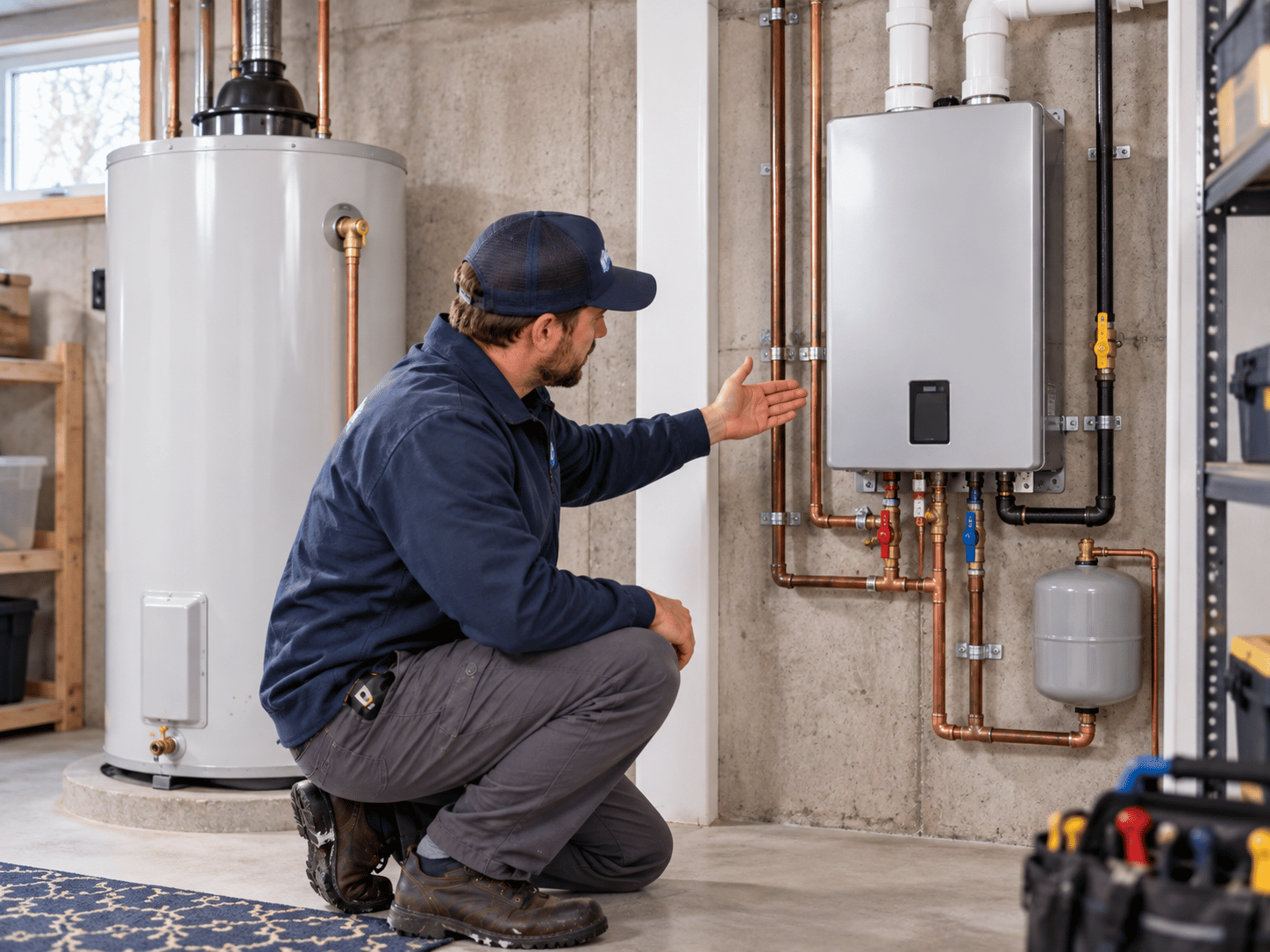
Hot water is one of those things nobody thinks about until it stops. You turn the handle, it gets warm, life goes on. Then one morning the shower runs cold, or you find a puddle around the tank in the basement, and suddenly you are making a decision you have not thought about in fifteen years.
When that happens, the question almost everyone asks us is the same one: should I just put in another tank, or should I finally go tankless?
There is no single right answer. Anyone who tells you tankless is always better, or that tanks are always the smarter buy, is selling something. The honest answer depends on how much hot water your household actually uses, how your house is built, what fuel you have, where the unit sits, and how long you plan to stay.
Cool As Ice has been working on water heaters in Fairfield County for more than 30 years. We install both. We repair both. We have talked plenty of homeowners out of tankless when it did not fit their house, and we have talked others out of another tank when tankless clearly made more sense. This article is our attempt to lay out the real tradeoffs in plain language so you can walk into the decision informed.
What a Tank Water Heater Actually Does
A storage tank water heater is exactly what it sounds like. A 40-, 50-, 75-gallon or larger tank sits in your basement or utility closet, keeps that volume of water hot around the clock, and delivers it whenever you open a tap. When you draw hot water out, cold water flows in at the bottom and the burner or element fires to bring it back up to temperature.
The appeal is simplicity. The technology has been refined for decades. Parts are common, the installation is usually straightforward, and most plumbers and HVAC technicians in Connecticut can service one without specialized training.
The tradeoff is standby loss. The tank is heating and reheating water whether or not anyone is home. It is also finite: once you have drained the hot water, you wait for recovery.
According to the U.S. Department of Energy's Energy Saver program, storage water heaters have a typical life expectancy of 10 to 15 years.
What a Tankless Water Heater Actually Does
A tankless, or demand-type, water heater has no storage at all. When you open a hot tap, a flow sensor tells the unit to fire, and water is heated as it passes through a heat exchanger. When you close the tap, it shuts off.
Because there is no tank sitting there losing heat, standby loss largely disappears. Because there is no tank, you do not run out in the conventional sense — as long as demand stays within what the unit can produce, it will keep going.
The Department of Energy's Energy Saver guidance puts the typical life expectancy of a tankless water heater at about 20 years, compared with 10 to 15 for a storage model. ENERGY STAR makes the same point on its whole-home gas tankless page, stating that tankless water heaters have a life expectancy of 20 years, much longer than any conventional tank-type water heater.
That longer service life is a real part of the value calculation, and it is one of the few claims in this category that both federal sources back up consistently.
CALL TO ACTION
Not sure which type fits your house? We will look at your existing setup, your fuel supply, your venting, and how your household actually uses hot water before recommending anything. Book a 45-minute appointment, contact us, or call Rudy directly at (203) 515-1141.
The Numbers That Are Actually Verified
There is a lot of loose math floating around about water heaters. Here is what the federal sources actually say, with attribution, so you can check it yourself.
- The U.S. Department of Energy's Energy Saver program reports that the average household spends 14% to 18% of its utility bill on water heating, which it puts at roughly $400 to $600 each year.
- The same Department of Energy guidance states that tankless models are 8% to 34% more efficient than storage water heaters. That is a wide range, and the range is the point — efficiency gains depend heavily on how much hot water the household uses and how it uses it.
- ENERGY STAR estimates that an ENERGY STAR certified whole-home gas tankless water heater saves a family of four about $95 per year compared with a standard gas storage model, and about $1,800 over the unit's lifetime.
- ENERGY STAR also estimates that a certified tankless unit saves about $20 annually and $300 over its lifetime compared with a conventional, non-certified gas tankless model.
Notice what is not in that list: an installed price. We are not going to quote you a number in a blog post, because water heater installation cost in Fairfield County depends on gas line sizing, venting runs, electrical work, permit requirements, and what we find when we open up the existing setup. Any company that gives you a firm price before seeing the space is guessing, and guesses tend to grow once the work starts.
Where Tankless Genuinely Wins
We recommend tankless without hesitation in several situations.
- Long hot water draws. Big soaking tubs, households where showers run back to back, or anyone who has ever run out mid-rinse.
- Space is tight. A wall-mounted tankless unit frees up several square feet of floor. In a Norwalk condo or a converted Stamford utility closet, that matters more than people expect.
- You plan to stay put. The efficiency advantage and the longer expected service life only pay off if you are around to collect them. If you are selling in two years, the math changes.
- The existing tank is in a finished space you want back. We have done this in Westport and New Canaan basements more than once.
- Vacation or second homes. A unit that does not heat water when nobody is there has an obvious advantage.
Where a Tank Is Still the Right Answer
And here is the part a lot of HVAC websites leave out. Tanks are frequently the better choice.
- Your gas line cannot support it. Whole-home gas tankless units draw significantly more gas at peak than a storage heater. If the existing supply line is undersized, upsizing it can add meaningful cost and disruption. Sometimes it is not practical at all.
- Venting is a problem. Tankless units generally need their own dedicated venting, often to an exterior wall. In older Fairfield County homes with finished basements, interior chimneys, or tight lot lines, the vent path can be the hardest part of the job.
- Simultaneous demand is high but brief. If three showers run at once for ten minutes each morning, a properly sized tank may serve you better and cheaper than a tankless unit sized for that peak.
- Budget is the constraint right now. A tank replacement is usually the lower up-front cost. If money is tight and the old tank just failed, we will tell you that plainly rather than pushing an upgrade.
- You are electric-only with limited panel capacity. Whole-home electric tankless units can require substantial electrical service. An older panel in a Trumbull or Fairfield cape may need upgrading, and that is a separate project.
The Connecticut-Specific Catch: Cold Incoming Water
This is the piece most national articles skip, and it matters a great deal here.
A tankless water heater does not produce a fixed amount of hot water. It produces a temperature rise. The colder the water coming into your house, the harder the unit has to work to reach your set temperature, and the fewer gallons per minute it can deliver while doing it.
In Connecticut, groundwater and municipal supply temperatures drop substantially in winter. A tankless unit that comfortably runs two showers in August may struggle to run the same two showers in January. This is not a defect. It is physics, and it is why sizing has to be done for your coldest conditions, not your average ones.
When a homeowner in Ridgefield or Wilton tells us their neighbor's tankless cannot keep up, this is almost always why. The unit was sized on a mild-weather assumption, or sized for the house rather than for the household's actual simultaneous demand in February.
A contractor who sizes a tankless unit for a Connecticut home without asking about winter incoming water temperature and simultaneous fixture use is not doing the job properly. That is a fair question to ask any company you are considering, including us.
Installation Realities in Older Fairfield County Homes
Our service area includes a lot of housing stock built long before anyone imagined a tankless water heater. Norwalk, Stamford, Greenwich, Darien, New Canaan, Westport, Fairfield, Wilton, Weston, Ridgefield and Trumbull all have neighborhoods where the mechanical room was designed around a single appliance and never revisited. We work in select Westchester County communities too, including Rye, Armonk, Bedford and Pound Ridge, where the same constraints show up.
Here is what actually has to be evaluated before anyone can responsibly recommend tankless:
- Gas supply and meter capacity. Can the existing line and meter deliver peak demand with the furnace or boiler also running?
- Vent routing. Where does the exhaust go, how far is the run, and does the termination point meet clearance requirements from windows, doors and soffits?
- Condensate handling. Condensing units produce acidic condensate that needs a proper drain and, often, neutralization.
- Water quality and hardness. Hard water scales heat exchangers. If your water is hard, descaling becomes a routine maintenance item, not an optional one.
- Electrical. Even gas tankless units need power. Electric tankless units need considerably more.
- Recirculation. If you currently have a recirculation loop for fast hot water at distant fixtures, that has to be accounted for in the design, not bolted on afterward.
- Permits and inspection. Water heater replacement generally requires a permit from your town's building department. Your contractor should be pulling it, not asking you to.
If any of those come back as a hard problem, that is not a reason to panic. It is a reason to have an honest conversation about whether a high-efficiency tank is the smarter buy for your particular house. We do that conversation a lot, and nobody has ever been upset that we saved them from a project that did not fit.
CALL TO ACTION
We will walk your basement, check your gas line and venting, and tell you honestly whether tankless makes sense for your home — including when it does not. Book a 45-minute appointment, contact us, or call Rudy directly at (203) 515-1141.
What About Indirect and Heat Pump Water Heaters?
Tank versus tankless is not the whole menu, and in Connecticut two other options come up constantly.
Indirect water heaters use your existing boiler to heat a storage tank through a heat exchanger. If you already have a well-functioning boiler — and plenty of homes in Greenwich, Darien and New Canaan do — an indirect can be an efficient, quiet, long-serving choice. The Department of Energy's Energy Saver lifespan table lists indirect water heaters at approximately 10 years, though that figure depends heavily on the tank and the water quality.
Heat pump water heaters move heat rather than generate it, and they are meaningfully more efficient than standard electric resistance tanks. The Department of Energy lists their typical life expectancy at 10 to 15 years. They need adequate air volume around them and they cool and dehumidify the space they sit in, which can be a bonus in a damp basement and a problem in a small closet. They are also the category most likely to carry Connecticut utility incentives, which we cover below.
If you have a boiler, ask about indirect. If you are all-electric, ask about heat pump. Either one may beat both of the options in this article's title for your specific house. Our hot water systems page covers the equipment we work with.
Maintenance: Both Types Need It
People sometimes choose tankless believing it is maintenance-free. It is not. In some ways it needs more attention than a tank.
For storage tanks:
- Flush sediment periodically, especially with hard water.
- Check and replace the anode rod before it is fully consumed — this is the single most overlooked thing that shortens tank life.
- Test the temperature and pressure relief valve.
- Look for corrosion at fittings and at the base.
For tankless units:
- Descale the heat exchanger on the manufacturer's recommended interval, more often with hard water.
- Clean the inlet filter screen.
- Inspect venting and the condensate drain.
- Check for error codes stored in the controller, which often flag a developing issue before you notice anything.
Skipped descaling is the number one reason we see tankless units underperform in this area. The efficiency numbers from ENERGY STAR and the Department of Energy assume equipment that is maintained. A scaled heat exchanger will not deliver them. We fold water heater checks into our regular HVAC maintenance visits for exactly this reason.
How to Decide: A Short, Honest Checklist
Run through these before you call anyone.
- How old is the current unit? If a tank is under eight years old and the problem is a thermostat, element or valve, repair it. Do not let anyone convert a repairable failure into a replacement sale.
- Has it leaked from the tank body? A leaking tank is not repairable. A leaking fitting often is. There is a real difference and a good technician will show you which one you have.
- Do you actually run out of hot water? If you never run out, the main functional advantage of tankless does not apply to you.
- How long are you staying? Under five years, the payback case for tankless weakens considerably.
- What fuel do you have, and what capacity? This determines what is even possible.
- How hard is your water? Hard water raises the maintenance commitment on tankless.
- Is floor space worth money to you? Sometimes it genuinely is.
Rebates and Incentives in Connecticut
Connecticut runs its ratepayer-funded efficiency programs under the Energize Connecticut banner, and residential incentives for water heating equipment — particularly heat pump water heaters — are offered through that program. We are not going to print dollar amounts here, because incentive levels and eligibility rules change and a stale number in a blog post is worse than no number at all.
What we will do is tell you what is currently available for the specific equipment you are considering at the time you are considering it, and point you to the official program materials so you can verify it yourself. Anyone quoting you a rebate amount without checking the current program terms is guessing, and you should treat that as a warning sign.
What We Tell People Who Call Us
When someone calls the office and says they want a tankless, the first thing we ask is why. Sometimes the answer is that they run out of hot water every morning, and tankless is likely the right call. Sometimes it is that they heard tankless is more efficient, and then we talk through the Department of Energy's 8% to 34% range and what it would realistically mean for their household and their fuel costs.
And sometimes the answer is that the tank is leaking and they need hot water today. In that case, the right move is usually a quality tank installed properly this week, not a two-week tankless project with a gas line upsize. We will say so.
That is the whole philosophy here. We are a family-owned shop. Rudy is our head mechanic and he answers his own phone. We are not working off a commission sheet, and we would rather do the right job for you now and be the company you call in ten years than sell you the biggest ticket available today. If the fix is a small part, we will tell you it is a small part.
If your water heater fails at 11pm on a Saturday, our emergency HVAC service line is available 24/7. If it is a nagging problem rather than a crisis, our service and repair team can take a look during normal hours. And if you are planning ahead for a replacement next spring, that is genuinely the best time to call, because you get to make the decision calmly.
CALL TO ACTION
Whether you are replacing a failed tank today or planning an upgrade for next year, we will give you a straight assessment and a real estimate — no pressure, no upsell. Book a 45-minute appointment, contact us, or call Rudy directly at (203) 515-1141.
Frequently Asked Questions
Will a tankless water heater really never run out of hot water?
Not exactly. A tankless unit will run indefinitely as long as demand stays within its capacity at the current incoming water temperature. Exceed that — three showers and a dishwasher in January — and the unit will maintain flow but not your set temperature. This is why correct sizing for Connecticut winter conditions matters so much.
How much more efficient is tankless, really?
The U.S. Department of Energy's Energy Saver program states tankless models are 8% to 34% more efficient than storage water heaters. Where you land in that range depends primarily on how much hot water your household uses. Lower-use households tend to see the larger percentage gains, because they are eliminating proportionally more standby loss.
How long do water heaters last?
The Department of Energy's Energy Saver lifespan guidance lists storage water heaters at 10 to 15 years, tankless at approximately 20 years, heat pump water heaters at 10 to 15 years, and indirect water heaters at approximately 10 years. Actual life depends on water quality, maintenance and installation quality.
Do I need to upgrade my gas line for a tankless water heater?
Sometimes. Whole-home gas tankless units draw more gas at peak than a storage tank, so the existing supply line and meter have to be evaluated against total household demand. In some homes no change is needed. In others the upsize is the largest single line item in the project, which is exactly why it has to be checked before a price is quoted.
Does hard water affect tankless water heaters?
Yes, significantly. Scale builds on the heat exchanger and reduces both efficiency and capacity. Tankless units in hard-water homes need descaling on the manufacturer's recommended schedule. If you are not prepared to keep up with that, a tank may serve you better.
Is my leaking water heater repairable?
It depends where it is leaking from. Leaks at fittings, valves, or the relief line are frequently repairable. A leak from the tank body itself means the tank has corroded through and it needs to be replaced. A technician should show you the source rather than just telling you it is done.
Should I replace a water heater that still works?
Usually not, on age alone. If a unit is operating properly and has been maintained, there is no rule that says a particular birthday requires replacement. The reasons to replace proactively are a history of repairs, visible corrosion, capacity that no longer suits the household, or a unit located above finished space where a failure would cause real damage.
Do you service water heaters you did not install?
Yes. We service a wide range of equipment regardless of who installed it. You can see the towns we cover on our service areas page, and more general questions are answered on our FAQs page.
About Cool As Ice HVAC
Cool As Ice HVAC is a family-owned heating, cooling and hot water company based in Norwalk, Connecticut, with more than 30 years of experience serving local homeowners and businesses. We handle residential HVAC, hot water systems, maintenance, repairs and emergency service.
- Office: (203) 515-7693
- Rudy Jimenez, head mechanic, direct: (203) 515-1141
- Hours: Monday through Friday, 7am to 6pm; Saturday, 8am to 4pm; emergency service available 24/7
- Fairfield County service area: Norwalk, Stamford, Greenwich, Darien, New Canaan, Westport, Fairfield, Wilton, Weston, Ridgefield and Trumbull
- Select Westchester County, NY service area: Rye, Armonk, Bedford and Pound Ridge
Experienced service. Family-owned care. Comfort you can count on.