Every year it happens the same way. April is cool, May is pleasant, nobody thinks about air conditioning. Then a Tuesday in late May hits 88 degrees, everyone in Fairfield County reaches for the thermostat at roughly the same hour, and our phone does not stop ringing until Friday.
The systems that fail on that Tuesday did not break that Tuesday. They were already compromised — a failed capacitor, a clogged condensate line, a slow refrigerant leak, a seized contactor — and the first real demand of the season simply revealed it.
That is the entire argument for a spring startup check. Not because your system is necessarily in trouble, but because finding out in April, on a 60-degree day when you have options, is a completely different experience from finding out in July with a house full of people and every contractor in the county booked solid.
This article walks through what you can check yourself, what a real professional startup covers, and the specific warning signs that mean you should stop and call somebody.
Why the First Hot Week Is the Worst Time to Find Out
Air conditioning equipment sits idle for roughly seven months in Connecticut. During that time a lot can happen:
- Rodents nest in the outdoor unit or chew low-voltage wiring
- Leaves, mulch and landscaping debris pack the condenser coil
- Condensate lines dry out and the residue hardens into a clog
- Capacitors sitting through temperature swings degrade
- Refrigerant that was slowly leaking last August has kept leaking all winter
- Contactors corrode or pit
- Filters left in over the winter while the furnace ran are now thoroughly loaded
None of that announces itself. The system looks exactly the same in April as it did in September. It only shows up when you ask it to work.
ENERGY STAR's maintenance guidance recommends scheduling cooling system check-ups in the spring and heating system check-ups in the fall, which is simply an acknowledgement that equipment should be tested before the season it has to carry — not during it.
Start With a Test Run on a Mild Day
If you do nothing else from this article, do this.
Pick a day in April or early May when it is at least 60 degrees outside. Switch the thermostat to cool and set it several degrees below room temperature. Let the system run for 15 to 20 minutes. Then go look and listen.
One caution that matters: most manufacturers advise against running a central air conditioner when outdoor temperatures are below roughly 60 degrees, because the oil in the compressor is too thick and the pressures are wrong. If it is 45 degrees out, wait. This is a mild-day test, not a cold-day test.
Twenty minutes of running on a mild day will surface the large majority of problems while they are still inexpensive and while your house is not depending on the answer.
CALL TO ACTION
Want it checked properly before the heat arrives? Spring is our least crowded season and the best time to get on the schedule. Contact us or call Rudy directly at (203) 515-1141.
The Homeowner's Own Checklist
These are things you can safely do yourself, in order.
- Replace the filter. Start here. It is the cheapest, highest-return thing you can do. The U.S. Department of Energy's Energy Saver guidance states that replacing a dirty, clogged filter with a clean one can lower an air conditioner's energy consumption by 5% to 15%. ENERGY STAR recommends inspecting, cleaning or changing filters once a month during the season.
- Clear the outdoor unit. Give the condenser at least a couple of feet of open space on all sides. Pull out leaves, cut back shrubs, move the trash cans, and remove any cover you put on for winter. A covered condenser that gets energized is a bad day.
- Look inside the condenser from above. Without removing panels, look down through the top grille for leaves, nesting material or debris sitting on the fan. If you see a nest, do not reach in. Turn the disconnect off and call.
- Rinse the coil gently. With the power off at the disconnect, a garden hose on low pressure from the outside in will clear surface dirt from the fins. Do not use a pressure washer. Bent fins restrict airflow permanently.
- Check the condensate drain. Find the PVC line coming off the indoor coil. Make sure the pan under the coil is dry and the drain is flowing. A clogged condensate line is one of the top causes of a mid-summer shutdown and water damage to whatever is below it.
- Fresh thermostat batteries. Two minutes, and it eliminates the single most embarrassing service call.
- Confirm the disconnect and breakers. There is usually a pull-out disconnect box near the outdoor unit. Make sure it is in. Check that the breaker at the panel has not tripped.
- Open every supply register and return grille. Furniture gets moved over winter. Registers get closed. Both reduce airflow, and airflow problems can reduce efficiency by up to 15% according to ENERGY STAR.
- Check the line set insulation. The larger of the two copper lines running to the outdoor unit should be wrapped in foam insulation along its whole length. Sun, weather and animals degrade it. Missing insulation costs you capacity.
- Time it. Note how long it takes to drop the indoor temperature one degree on that mild test day. Write it down. Next spring, that number is a useful baseline.
What Normal Startup Should Sound and Feel Like
When you call for cooling, here is roughly what should happen.
- The indoor blower starts, and air begins moving from the supply registers within a moment or two.
- The outdoor fan starts and the compressor engages, usually with a brief sound as it comes up to speed. It should settle into a steady hum, not a rattle or a grind.
- Air coming from the supply registers should feel meaningfully cooler than room air within several minutes.
- The larger copper line at the outdoor unit should get cold and may sweat. That is normal.
- The outdoor unit should discharge warm air out the top.
- Nothing should smell like burning, and nothing should be dripping where it did not drip before.
Variable-speed and two-stage equipment behaves differently and may start gently at low capacity. That is by design, not a fault.
Warning Signs That Mean Stop and Call
Some of these are comfort issues. Some are genuine safety or damage issues. Treat the list seriously.
- Ice on the refrigerant line or the indoor coil. Shut the system off at the thermostat, leave the fan running to melt it, and call. Running a system that is icing can damage the compressor. Ice usually means airflow restriction or low refrigerant charge, and both need diagnosis.
- The breaker trips when the system starts. Do not keep resetting it. Repeated resets into a fault are how small electrical problems become expensive ones.
- A loud hum from the outdoor unit with the fan not spinning. Turn it off. That is frequently a failed capacitor or a seized motor, and letting it sit there humming is hard on the compressor.
- Water around the indoor unit. Condensate problem. The longer it runs, the more damage to flooring, ceilings and framing below.
- A burning or electrical smell. Shut it down at the breaker and call.
- Grinding, screeching or metal-on-metal. Bearing or fan problem. Continuing to run it rarely ends well.
- It runs constantly and never satisfies the thermostat. Could be charge, airflow, a dirty coil, or a duct issue. All of them are cheaper to address in May than in August.
If any of those happen outside normal hours, our emergency HVAC service is available 24/7. If it is not urgent, our service and repair team can schedule you during regular hours, which is almost always less expensive.
CALL TO ACTION
Seeing ice, hearing something new, or finding water where it should not be? Do not keep running it. Contact us or call Rudy directly at (203) 515-1141.
What a Professional Spring Startup Actually Includes
ENERGY STAR publishes a maintenance checklist that lines up closely with what a proper visit covers. For any system, that includes checking thermostat settings, tightening all electrical connections and measuring voltage and current on motors, lubricating moving parts, checking and inspecting the condensate drain, and checking the controls of the system for proper operation.
On the cooling side specifically, ENERGY STAR lists cleaning the evaporator and condenser coils, checking the refrigerant level and adjusting if necessary, and cleaning and adjusting blower components — noting that airflow problems can reduce efficiency by up to 15%.
In practice, a spring visit from us looks like this:
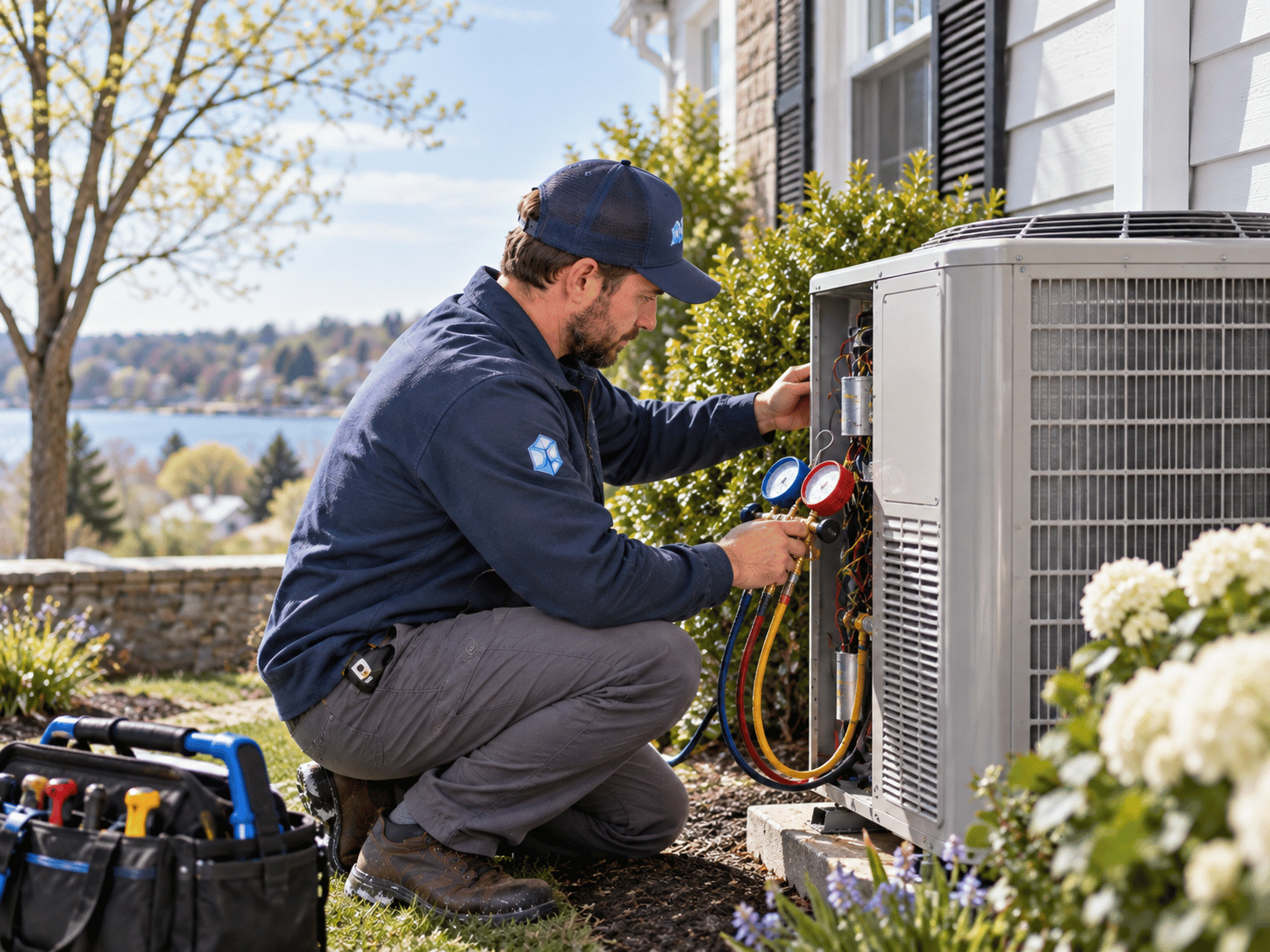
- Test the full startup sequence and watch what the equipment does, not just whether it comes on
- Measure temperature split across the indoor coil
- Check refrigerant pressures against ambient conditions
- Measure amp draw on the compressor and fan motors against nameplate
- Test capacitors under load, since a weak capacitor often reads fine visually
- Inspect and clean the condenser coil properly, which means more than a hose rinse
- Clear and treat the condensate drain and verify the safety switch works
- Inspect electrical connections and the contactor for pitting
- Check thermostat calibration and programming
- Look at accessible ductwork and return air path
The point of measuring rather than eyeballing is that it produces numbers you can compare year over year. A compressor drawing noticeably more amps than it did last spring is telling you something before it fails.
The Refrigerant Conversation, Honestly
This is where homeowners get taken advantage of most often, so we want to be direct about it.
A properly installed, properly sealed air conditioning system does not consume refrigerant. It is a closed loop. If your system is low on refrigerant, it is because refrigerant escaped, which means there is a leak.
Topping it off every spring is not maintenance. It is paying annually to replace something that is leaking out, without addressing why. Sometimes a top-off is a reasonable stopgap — an older system where the repair does not justify the cost and you want to get another season out of it — and that can be a legitimate choice. But it should be presented to you as a stopgap, with the leak acknowledged, not sold as routine service.
If someone adds refrigerant to your system without discussing where it went, ask. A good technician will perform a leak search and show you what they found.
If You Have a Heat Pump
Heat pumps run all year, so the spring check has a different emphasis: verifying that changeover into cooling mode works correctly.
- The reversing valve needs to shift properly. A stuck reversing valve produces heat when you asked for cooling, and it is a distinct failure from anything a conventional AC does.
- The defrost control gets a break for the season, but it should still be checked.
- Auxiliary and emergency heat should be locked out during cooling operation. If backup electric heat is energizing in July, your electric bill will tell you about it.
- Because a heat pump ran hard all winter, spring is when accumulated wear shows. Amp draws and capacitor readings matter more here than on a system that sat idle.
More on the equipment types we service is on our cooling systems and heating systems pages.
Humidity Is Half the Job Around Here
Fairfield County summers are humid, and the closer you are to the water the more that matters. Homeowners in Norwalk, Westport, Darien, Greenwich and across the line in Rye deal with a lot of moisture in the air.
An air conditioner dehumidifies by running long enough for moisture to condense on the cold coil and drain away. Short cycles cool the air without removing much water, which is why an oversized system can leave a house that reads 72 degrees and still feels clammy.
Things to notice during your spring test:
- Are cycles very short — on for a few minutes, off, on again?
- Does the house feel damp even when the temperature is satisfied?
- Is there condensation on windows, or a musty smell when the system first starts?
- Is the condensate drain producing water at all during a long run? If nothing is draining on a humid day, something is wrong.
These are fixable, and the fix is usually not a new system. Airflow adjustment, thermostat configuration, a longer minimum run time, or addressing a duct problem often resolves it.
If Your System Struggled Last Summer
Think back to July and August. Did the upstairs never really get comfortable? Did the system run all day during the hot stretch? Did you find yourself dropping the thermostat two more degrees hoping it would catch up?
Those memories fade by October and come back in June, usually too late to do anything calmly about them. Spring is the window to investigate.
A system that could not keep up might have a charge problem, a dirty coil, a duct leak, a blower issue, or a genuine capacity shortfall. Those are four cheap answers and one expensive one, and you should know which you have before the season starts rather than being told during a heat wave that you need a new system today.
What We Will Not Do on a Spring Visit
We are a family-owned shop in Norwalk. Rudy is our head mechanic and he has been doing this for decades. Here is our position on spring startups.
We are not going to show up, look at the age sticker on your condenser, and open with a replacement quote. Age is not a diagnosis. We have plenty of customers running well-maintained equipment that is older than the industry's favorite talking points, and it works fine because it has been looked after.
We are not going to add refrigerant without telling you there is a leak. We are not going to recommend a duct cleaning as a reflex. And if the whole problem is an inexpensive part and a clogged drain line, the invoice is going to reflect an inexpensive part and a clogged drain line.
What we will do is test the system properly, give you the measurements, tell you what is fine, what is marginal and what needs attention, and let you decide. If replacement genuinely is the right call — a failed compressor on a 20-year-old unit, for example — we will explain exactly why and what the alternatives are, including doing nothing for now.
You can read more about how we work on our about page, check whether we cover your town on our service areas page, or see our full HVAC maintenance offerings.
CALL TO ACTION
Get on the spring schedule before the first hot week fills it up. We will test it properly and tell you straight what it needs. Contact us or call Rudy directly at (203) 515-1141.
Frequently Asked Questions
When should I test my air conditioner in Connecticut?
April into early May, on a day when it is at least 60 degrees outside. Most manufacturers advise against running central air below roughly 60 degrees because compressor oil viscosity and system pressures are wrong at low ambient temperatures. Testing early gives you weeks of lead time if something needs a part.
How often should I change my air filter?
ENERGY STAR recommends inspecting, cleaning or changing filters once a month during the cooling and heating seasons. The Department of Energy's Energy Saver guidance states that replacing a dirty, clogged filter with a clean one can lower an air conditioner's energy consumption by 5% to 15%, which is a large return for a small task.
Can I clean the outdoor unit myself?
You can safely clear debris and rinse the coil gently with a garden hose after turning off the disconnect. Do not use a pressure washer, do not bend the fins, and do not remove panels or reach inside. Anything past a surface rinse — including the interior of the coil, which is where most of the dirt actually accumulates — is a job for a technician.
Why is there ice on my air conditioner?
Ice almost always means restricted airflow or low refrigerant charge. Turn off cooling, leave the fan running to thaw the coil, and have it diagnosed. Running an iced system risks liquid refrigerant reaching the compressor, which is the most expensive component in the system.
Does my air conditioner need refrigerant every year?
No. A sealed system does not consume refrigerant. If it is low, it leaked. Annual top-offs without a leak search are a recurring charge for an unaddressed problem, and you are entitled to ask where the refrigerant is going.
My house is cool but feels damp. What is wrong?
Usually short cycling. Dehumidification requires sustained run time for moisture to condense on the coil and drain. Very short cycles hit the temperature setpoint without removing much water. Causes include oversized equipment, airflow settings, thermostat configuration, or duct issues, and most of them are adjustable without replacing anything.
Should I cover my outdoor unit in winter?
Condensers are built for outdoor exposure. A full wrap can trap moisture and give rodents a sheltered place to nest. If you use any cover at all, it should be a top-only cover, and the critical part is remembering to remove it before the system is energized in spring.
How long does a spring AC check take?
A thorough startup visit on a typical residential system generally runs about an hour, longer for multiple systems or zoned equipment. We book 45-minute appointments for evaluations and consultations; a full maintenance visit is scheduled accordingly. More general questions are answered on our FAQs page.
About Cool As Ice HVAC
Cool As Ice HVAC is a family-owned heating and cooling company based in Norwalk, Connecticut, with more than 30 years of local experience. We provide residential HVAC maintenance, repair, installation and emergency service.
- Office: (203) 515-7693
- Rudy Jimenez, head mechanic, direct: (203) 515-1141
- Hours: Monday through Friday, 7am to 6pm; Saturday, 8am to 4pm; emergency service available 24/7
- Fairfield County service area: Norwalk, Stamford, Greenwich, Darien, New Canaan, Westport, Fairfield, Wilton, Weston, Ridgefield and Trumbull
- Select Westchester County, NY service area: Rye, Armonk, Bedford and Pound Ridge
Experienced service. Family-owned care. Comfort you can count on.