
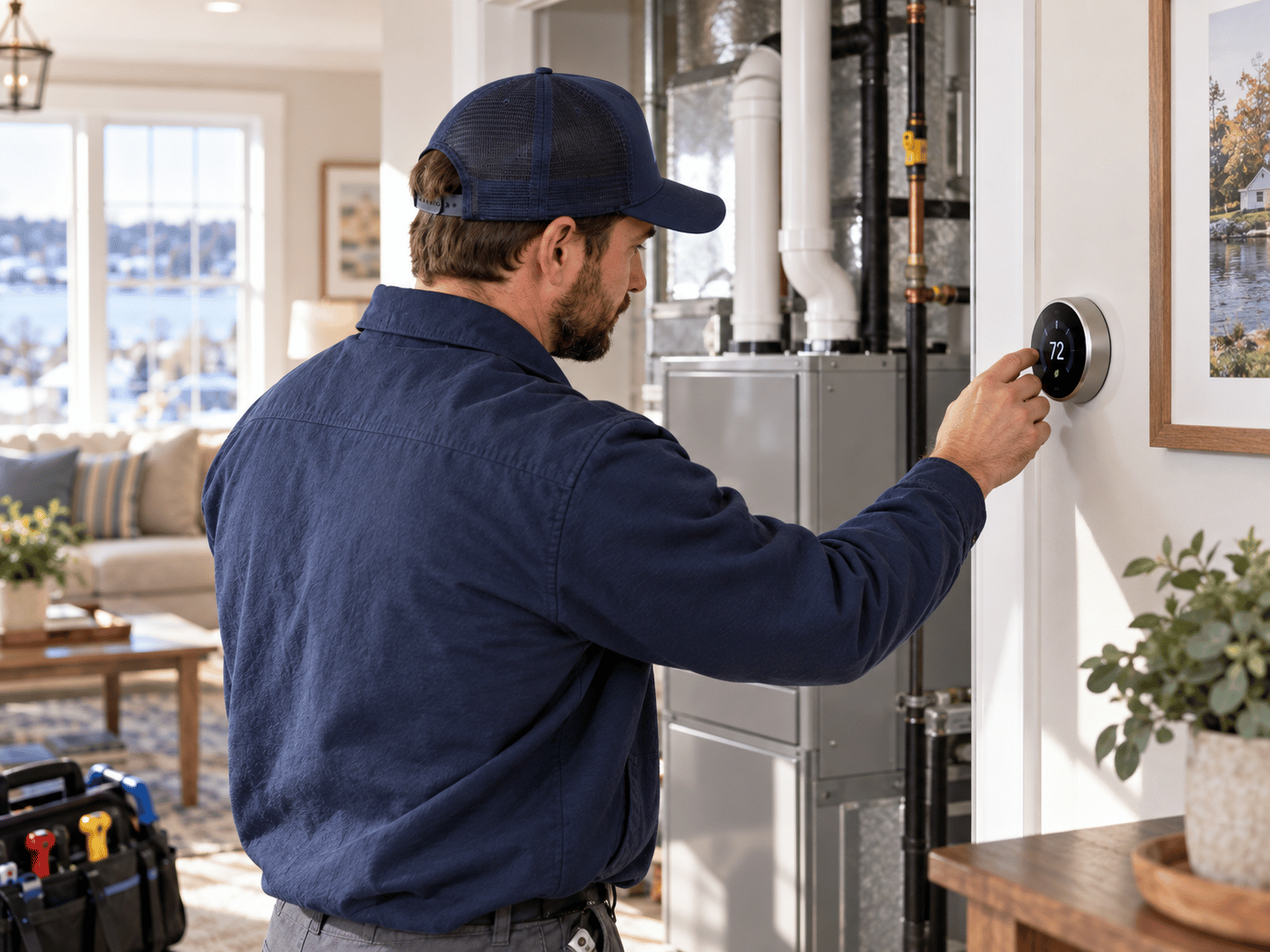
A smart thermostat is a good product. We install them. We like them. Several of us have one at home.
We also spend a fair amount of time in Fairfield County basements explaining to disappointed homeowners why the thermostat they bought in October did not solve the problem they bought it for.
That gap between what smart thermostats are marketed to do and what they actually do is the reason for this article. Not to talk you out of one. To make sure that if you buy one, you buy it for the right reason, and that you do not skip the thing that would have actually fixed your comfort problem.
Cool As Ice is a family-owned HVAC company in Norwalk with more than 30 years of local experience. We do not sell thermostats as an upgrade package and we do not get a cut from any manufacturer. We just install and service the things, and we have a pretty clear view of where they help and where they do not.
First, What a Smart Thermostat Actually Is
A thermostat is a switch. That is the honest starting point.
Its job is to measure the temperature where it is mounted and tell your heating or cooling equipment to turn on or off. Everything else, every feature, every app, every colorful chart, is layered on top of that one function.
A basic mechanical thermostat does this with a simple sensing element. A programmable thermostat does it on a schedule you enter on the device. A smart thermostat does it on a schedule too, but adds a network connection, which unlocks remote control, usage reporting, automatic adjustments based on location or occupancy, software updates, and integration with other systems.
That connection is genuinely useful. But notice what did not change: it is still a switch. It can decide when your equipment runs. It cannot change what your equipment does while it is running.
Hold onto that distinction, because almost every disappointment we see traces back to it.
The Savings Question, Answered Honestly
Here is what reputable federal sources actually say, with attribution, so you can check it yourself.
ENERGY STAR states that for the average American household, almost half of the annual energy bill goes to heating and cooling, which it puts at more than $900 a year. That number establishes why the category matters at all. It is a big share of the bill.
The U.S. Department of Energy's Energy Saver program states that you can save around 10 percent a year on your heating and cooling bills by turning your thermostat back 10 to 15 degrees Fahrenheit for eight hours. The same guidance notes that 68 degrees Fahrenheit is a good guideline in the winter.
Read that Department of Energy statement carefully, because it is the most misused sentence in this entire product category. It is a statement about setting your thermostat back. It is not a statement about smart thermostats. An inexpensive programmable thermostat, correctly programmed, produces that setback. So does walking over and turning the dial down before you leave the house.
What a smart thermostat contributes is reliability. It makes the setback happen automatically, every day, without anyone remembering. That is worth real money in a household that would not otherwise be consistent. It is worth close to nothing in a household that was already disciplined about it.
ENERGY STAR does certify smart thermostats, and says certified models have been independently certified, based on actual field data, to deliver energy savings. That is a meaningful distinction if you are shopping. It is not a promise about your house.
We will not quote you a savings figure for your home, because nobody can. Your savings depend on your schedule, your current habits, your equipment, your insulation, your ductwork, and your weather. A family in Weston that already sets back manually will see less than a family in Stamford that leaves 72 degrees running all day in an empty house.
CALL TO ACTION
If your comfort problem has a mechanical cause, a thermostat will not find it. We will. Have us look at the system before you spend money on controls. Book a 45-minute appointment, contact us, or call Rudy directly at (203) 515-1141.
What Smart Thermostats Genuinely Do Well
We want to be fair here. There are real benefits, and they are the reason we install these things.
- Automatic, consistent scheduling. The setback happens whether or not anyone remembers. For most households this is the single largest practical benefit.
- Remote control. Turning the heat up from the car on the way back from a weekend away is genuinely useful, especially for second homes and for anyone who travels.
- Visibility. Usage reports show how many hours your equipment ran. That is diagnostic information most homeowners have never had, and it is often the first clue that something is wrong.
- Geofencing and occupancy sensing. For households with irregular schedules, this can capture savings a fixed program would miss.
- Alerts. Low-temperature alerts are legitimately valuable in Connecticut. A phone notification that the house is at 48 degrees while you are away can be the difference between a service call and a burst pipe.
- Filter and maintenance reminders. Imperfect, but better than nothing for people who never think about the filter.
- Vacation and away modes. Easier to use correctly than the equivalent features on older programmable units, which many people never figured out.
Those are real. If any of them describe a problem you have, a smart thermostat is a reasonable purchase.
Now the Honest Part: What They Do Not Fix
This is the section we wish more homeowners read before buying.
They do not fix airflow. If a room is not getting enough conditioned air, the reason is somewhere between the equipment and the register. Undersized ducts, crushed flex, a restrictive filter, a failing blower, closed or blocked registers, poor return air. A thermostat measures temperature at one spot on one wall. It has no ability to move more air into a room that is not getting enough.
They do not fix equipment sizing. An oversized furnace or air conditioner satisfies the thermostat quickly and shuts off, leaving temperature swings and, in cooling, poor humidity removal. An undersized system runs continuously and never catches up. A smart thermostat can show you this pattern in its reports, which is genuinely useful. It cannot correct it. Sizing is determined at installation, using a load calculation such as ACCA Manual J, and no control will undo a bad one.
They do not fix ductwork. ENERGY STAR states that about 20 to 30 percent of the air that moves through the duct system is lost due to leaks, holes, and poorly connected ducts. Think about that for a moment. In a house with that problem, a meaningful share of the air your furnace heated never reaches a room at all. No thermostat setting recovers that air. The U.S. Department of Energy's Energy Saver guidance is equally direct, noting that ducts leaking heated air into unheated spaces can add hundreds of dollars a year to your heating and cooling bills.
They do not fix mechanical wear. A failing inducer motor, a dirty burner, a worn circulator, a contactor that is pitting, a blower wheel packed with dust. These are physical conditions in the equipment. A network connection does not reach them.
They do not fix refrigerant problems. If a cooling system is undercharged or has a leak, capacity drops. The thermostat will keep calling for cooling, the system will keep running, and the house will keep not getting cold. This is the fastest way to get a large electric bill and a disappointing summer.
They do not fix zoning and distribution design. If your second floor has always been hot in July and the first floor has always been cold in January, that is usually a distribution and design issue, sometimes a zoning issue, sometimes a building envelope issue. One sensor on a hallway wall cannot arbitrate between floors. Some thermostats support remote sensors, which helps a little by letting the control average or prioritize a different room, but that is managing the symptom, not fixing the cause.
They do not fix insulation and air sealing. If the house leaks heat, it leaks heat. Controls do not change the building.
They do not fix a system that is at the end of its life. We have been called to homes in Fairfield and Darien where a homeowner bought a smart thermostat hoping to squeeze another season out of a boiler that was clearly done. It did not work, and it was not going to.
The Compatibility Issue Nobody Mentions in the Ad
Smart thermostats are marketed as universal. They are not. In older Fairfield County housing stock, compatibility is a real and frequent issue.
- The C-wire. Most smart thermostats need continuous power, which usually means a common wire. Plenty of older installations in Norwalk, Fairfield, and Trumbull have four wires or fewer at the thermostat. Solutions exist, including adapters and running new wire, but they are work, and the adapters are not universally reliable across all equipment.
- Heat pumps. Heat pumps require the thermostat to manage auxiliary and emergency heat correctly. Getting this wrong is expensive, and we will come back to it.
- Multi-stage and modulating equipment. Two-stage furnaces, modulating boilers, and variable-speed systems need a control that speaks their language. A mismatched thermostat can leave you running a modulating boiler as if it were a simple on-off unit, throwing away the efficiency you paid for.
- Hydronic zoning. Homes with zone valves or zone circulators, common in older Connecticut houses with baseboard or radiators, have control wiring that does not always map cleanly onto a consumer smart thermostat.
- Line-voltage electric baseboard. This is 120 or 240 volts at the thermostat, not the low-voltage control wiring most smart thermostats expect. Installing a low-voltage thermostat on line-voltage baseboard is dangerous. There are line-voltage smart thermostats, but they are a different product.
- Millivolt systems. Some older equipment generates its own tiny control voltage and will not power a smart thermostat at all.
None of this means you cannot have one. It means somebody has to check before you buy, rather than after.
The Heat Pump Setback Trap
This one deserves its own section because it is the most common way a smart thermostat actively costs somebody money.
A heat pump moves heat rather than generating it, and it does that efficiently. But when a heat pump has to recover a large temperature gap quickly, many systems bring on auxiliary electric resistance heat to help. Electric resistance heat is comfortable and fast, and it is also a far more expensive way to make heat than running the heat pump itself.
Now put a deep setback schedule on that system. Every morning, the thermostat calls for a large recovery, and every morning the auxiliary heat contributes to it. The homeowner did exactly what the energy-saving advice said to do, and the bill went up.
Better smart thermostats handle this with adaptive or intelligent recovery, which starts the recovery earlier and more gradually so the heat pump can do the work alone. But the feature has to be present, enabled, and configured for your equipment. Out of the box, with an aggressive schedule, a heat pump homeowner can absolutely make things worse.
If you have a heat pump and you are shopping for a thermostat, this is the question to ask. We check it as a matter of course on heating system work, and it comes up often.
CALL TO ACTION
Have a heat pump, a modulating boiler, or a zoned hydronic system, and are not sure what control it actually needs? We will tell you what is compatible and what is not, before you buy. Book a 45-minute appointment, contact us, or call Rudy directly at (203) 515-1141.
Other Ways a Smart Thermostat Can Make Things Worse
We are not trying to scare anyone off. But these are real situations we have been called to fix.
- Bad placement carried forward. If the old thermostat was mounted in a bad spot, near a supply register, in direct sun, on an exterior wall, above a lamp, the new one inherits that bad spot. A smarter device reading a wrong temperature is still reading a wrong temperature.
- Learning features fighting an irregular household. Some units adapt to observed patterns. In a house with genuinely unpredictable occupancy, that adaptation can produce a schedule nobody wants, and people end up overriding it constantly.
- Aggressive setbacks in a cold snap. In a Connecticut January, dropping a house very far overnight can create long recovery periods and, in some buildings, real risk to plumbing in exterior walls or unheated spaces.
- Overriding a professionally configured control. If a contractor set up a specific configuration for multi-stage or outdoor-reset equipment, a consumer replacement can undo that.
- Masking a developing problem. Remote access makes it easy to nudge the temperature from your phone instead of noticing that the system is running far more than it used to. Convenience can delay a service call that should have happened.
How to Decide Whether You Actually Want One
Here is a practical way to think about it. Ask what problem you are trying to solve.
- I want the house cooler when we are out and warm when we get home, without thinking about it. Good reason. This is exactly what the product is for.
- I travel, or I have a second home in Ridgefield or Bedford, and I want to see and control it remotely. Good reason. Remote visibility and low-temperature alerts are worth it on their own.
- I want to understand how much my system actually runs. Good reason. The reporting is genuinely informative.
- My upstairs is always too hot. Wrong tool. This is a distribution, zoning, or envelope problem.
- My bills went up this year. Wrong tool, at least as a first step. Something changed, and you want to know what. A thermostat will not tell you why the equipment is running longer.
- One room is always cold. Wrong tool. Airflow, ductwork, or balancing.
- The system is old and I am hoping to get another winter out of it. Wrong tool. Have it evaluated.
- The air conditioning is not cooling well. Wrong tool, and possibly an expensive mistake. Get the cooling system checked.
What We Recommend Doing First
If comfort is the actual complaint, the sequence that makes sense is not complicated:
- Change the filter and confirm registers and returns are open and unobstructed.
- Have the system professionally inspected so you know its real condition.
- Address any airflow, ductwork, refrigerant, or mechanical problems found.
- Confirm the equipment is appropriately sized for the house, especially if it was replaced recently.
- Then, once the mechanical side is sound, add controls to manage it well.
Doing it in that order means the thermostat gets to do its actual job, which is controlling a system that works. Doing it in the reverse order means asking a switch to compensate for a mechanical problem, which it cannot do.
Regular HVAC maintenance is what keeps step two from turning into an emergency. That is not a sales line. A system that is inspected annually tends to hand you smaller problems earlier.
Installing One: Do It Yourself or Call Someone?
Plenty of homeowners install these successfully. The cases where we would push back:
- You do not have a C-wire and are considering an adapter on equipment you are not certain about.
- You have a heat pump with auxiliary heat.
- You have multi-stage, modulating, or variable-speed equipment.
- You have a zoned hydronic system with zone valves or multiple circulators.
- You have line-voltage baseboard.
- You are not certain what your existing wiring does, or the labels do not match anything.
- Your system is oil-fired and you are unsure how the controls are arranged.
Miswiring a thermostat can damage a control board, and a control board is a considerably more expensive object than a thermostat. If you are uncertain, our service and repair team handles this regularly and it is not a large job.
What We Actually Tell Customers
When somebody in Norwalk, Westport, Wilton, or New Canaan asks us whether they should get a smart thermostat, the answer is usually some version of this:
Yes, if you want convenience, consistency, remote access, and visibility. Those are real and you will probably be glad you did it.
No, if you are buying it hoping to fix a comfort problem. Find out what the comfort problem actually is first, because the thermostat will not find it and will not fix it, and you will have spent money without solving anything.
And either way, check compatibility before you buy, not after the box is open.
That is genuinely the whole of our position. We are not against the product. We are against buying it for the wrong reason, which is a thing we see often enough to write an article about.
CALL TO ACTION
Whether you need a thermostat, a repair, or just an honest opinion about what is going on with your system, we are happy to take a look. No upsell, no pressure. Book a 45-minute appointment, contact us, or call Rudy directly at (203) 515-1141.
Frequently Asked Questions
Will a smart thermostat lower my heating bill?
It can, if it changes your behavior. The U.S. Department of Energy's Energy Saver program states you can save around 10 percent a year on heating and cooling bills by turning your thermostat back 10 to 15 degrees Fahrenheit for eight hours. A smart thermostat makes that setback automatic and consistent. If you were already setting back manually, the additional savings are smaller. If you were not, the savings are real.
Will a smart thermostat fix my cold room?
No. A cold room is almost always an airflow, ductwork, balancing, zoning, or insulation issue. The thermostat measures temperature in one location and switches equipment on and off. It has no ability to send more air to a specific room. Some models support remote sensors, which can shift which room the system prioritizes, but that manages the symptom rather than fixing the cause.
Do I need a C-wire?
Most smart thermostats need continuous power, which usually means a common wire. Many older Connecticut homes do not have one at the thermostat. Options include running a new wire or using an adapter, though adapters are not universally reliable across all equipment. This is worth checking before you buy rather than after.
Are smart thermostats bad for heat pumps?
Not inherently, but they have to be configured correctly. Large overnight setbacks can trigger auxiliary electric resistance heat during recovery, which is a much more expensive way to heat. Thermostats with proper adaptive recovery for heat pumps handle this well, but the feature needs to be present and enabled. Ask about this specifically if you have a heat pump.
Is an ENERGY STAR certified model worth choosing?
If you are buying one anyway, yes. ENERGY STAR states that certified smart thermostats have been independently certified, based on actual field data, to deliver energy savings. That is a more substantive standard than manufacturer marketing.
What temperature should I set in winter?
The U.S. Department of Energy's Energy Saver guidance suggests 68 degrees Fahrenheit as a good winter guideline, with setbacks during the times you are normally out or asleep. That said, comfort is personal, and households with infants, elderly residents, or health considerations should set what is right for them.
Can I install one myself?
Many people do. We would recommend professional installation if you have a heat pump with auxiliary heat, multi-stage or modulating equipment, a zoned hydronic system, line-voltage baseboard, no C-wire, or wiring you cannot identify with confidence. Miswiring can damage a control board, which costs considerably more than the thermostat.
My bills went up. Should I buy a smart thermostat?
Not as the first step. A rise in bills usually means something changed: equipment condition, a developing mechanical problem, a duct issue, weather, or occupancy. A thermostat will show you that the system is running more, but it will not tell you why and will not fix it. Have the system looked at first.
About Cool As Ice HVAC
Cool As Ice HVAC is a family-owned heating and cooling company based in Norwalk, Connecticut, with more than 30 years of experience serving local homeowners and businesses.
- Office: (203) 515-7693
- Rudy Jimenez, head mechanic, direct: (203) 515-1141
- Hours: Monday through Friday, 7am to 6pm; Saturday, 8am to 4pm; emergency service available 24/7
- Service area in Fairfield County, CT: Norwalk, Stamford, Greenwich, Darien, New Canaan, Westport, Fairfield, Wilton, Weston, Ridgefield, and Trumbull
- Select Westchester County, NY communities: Rye, Armonk, Bedford, and Pound Ridge
We handle residential HVAC, commercial HVAC, and emergency HVAC service, and you can see everywhere we work on our service areas page. More answers are on our FAQs page, or read about our family business.
Sources referenced in this article: ENERGY STAR, Smart Thermostats and Heating and Cooling product guidance; ENERGY STAR, Duct Sealing guidance; U.S. Department of Energy, Energy Saver, thermostat and duct guidance; Air Conditioning Contractors of America (ACCA) Manual J residential load calculation standard.