
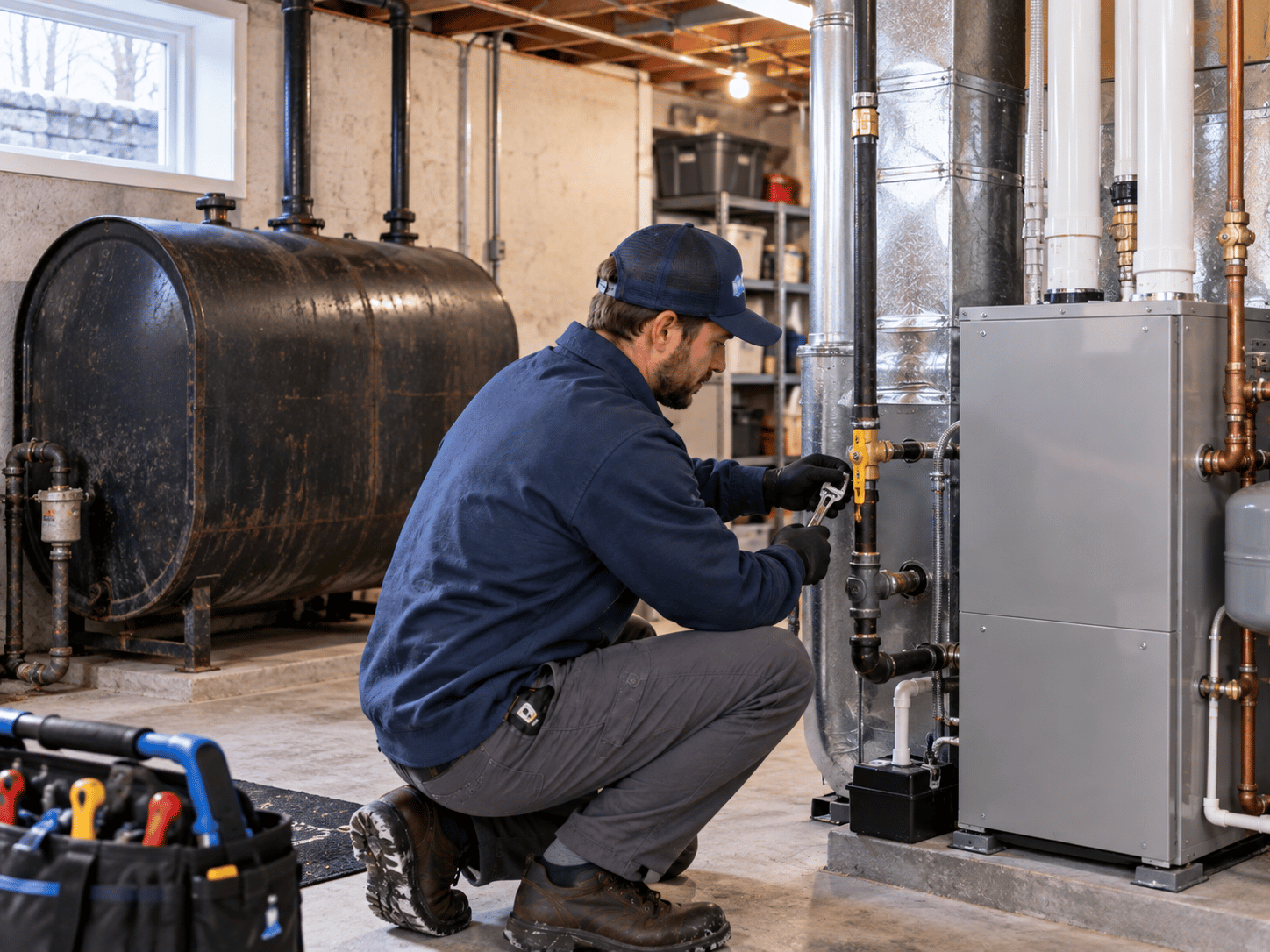
If you heat with oil in Fairfield County, you have probably had the conversation at least once. Maybe a neighbor in Norwalk switched to gas last year and mentioned it over the fence. Maybe your oil burner needed a repair in February and you started wondering how many more winters it has left. Maybe you saw a gas main being worked on down the street and thought, well, that changes things.
Oil to gas conversion is one of the most common questions we get at Cool As Ice, and it is also one of the most misunderstood. Homeowners tend to hear about it as a single decision, like switching cell phone carriers. In reality it is a sequence of separate projects that have to happen in the right order, involve more than one company, and depend heavily on things nobody can see from the curb.
This post walks through what the process actually involves. Not the sales pitch version. The real sequence, including the parts that surprise people, the parts that get skipped by contractors in a hurry, and the honest answer to the question everyone asks first.
Cool As Ice is a family-owned HVAC company based in Norwalk with more than 30 years of experience across Fairfield County. We work on oil equipment, gas equipment, boilers, furnaces, and heat pumps. We have no reason to push you toward one fuel. What we care about is that you understand what you are signing up for before you start.
Why This Question Comes Up So Often in Connecticut
Connecticut is one of the few states where heating oil is still a major residential fuel rather than a historical footnote. According to the U.S. Census Bureau's American Community Survey 2024 one-year estimates, about 35 percent of Connecticut households heat with fuel oil, and about 36 percent use utility gas. Those two numbers being almost identical is unusual nationally, and it explains a lot about why this conversation happens so frequently here.
It means roughly a third of the homes in towns like Norwalk, Stamford, Darien, Westport, Fairfield, Wilton, Weston, New Canaan, Ridgefield, and Trumbull still have an oil tank somewhere. It also means gas infrastructure exists in a lot of those same neighborhoods, sometimes running directly past houses that have never been connected to it.
So the question is rarely theoretical. For many Fairfield County homeowners, the gas main genuinely is out there in the street. The question is what it takes to get from the street into the house, and whether that makes sense for your particular property.
The First Question Is Not About Equipment. It Is About Your Street.
Before anyone talks to you about boilers, furnaces, efficiency ratings, or anything else, one thing has to be settled: is natural gas available at your address?
This is not a question an HVAC contractor can answer definitively. It is a utility question. The gas utility that serves your area maintains the distribution mains, and they determine whether service can be extended to a given property, what that extension would involve, and what the terms are.
Availability is not a simple yes or no. In our experience across Fairfield County, homeowners generally land in one of these situations:
- There is an active gas main in the street directly in front of the house, and a service line can be run to the property.
- There is a gas main nearby but not directly in front, and extending it would be a larger undertaking involving the utility, the town, and possibly other property owners.
- There is already a gas service line to the house, used for a range, dryer, water heater, or fireplace, but the meter and line may or may not be sized for a heating load.
- There is no gas main in the area at all, and there are no plans to extend one.
The last situation is more common in low-density parts of Weston, Wilton, Ridgefield, New Canaan, and Pound Ridge than it is in denser sections of Norwalk or Stamford. It is not about how nice the neighborhood is. It is about pipe.
If you are in that fourth category, the conversation should stop being about conversion and start being about whether your existing oil system can be improved, whether propane makes sense, or whether a heat pump is worth evaluating for your home. A good contractor will tell you that plainly instead of selling you a plan that cannot be executed.
CALL TO ACTION
Not sure whether gas is even an option at your address, or what your current system is worth keeping? We will come look at the property and give you a straight answer before anyone talks about buying anything. Book a 45-minute appointment, contact us, or call Rudy directly at (203) 515-1141.
The Full Sequence: What an Oil to Gas Conversion Actually Includes
Here is the honest shape of the project. Not every home needs every step, and the order can shift, but this is the general sequence:
- Site assessment and heat load evaluation of the home
- Confirming gas availability and applying for service with the utility
- Utility installation of the service line and meter
- Interior gas piping from the meter to the equipment location
- Removal of the existing oil-fired equipment
- Installation of the new gas heating equipment
- Venting and chimney work
- Connection to the existing distribution system, with modifications where needed
- Decommissioning, removal, or abandonment of the oil tank
- Permits, inspections, startup, and commissioning
That is ten steps involving at minimum your gas utility, a licensed heating contractor, a plumber or gas fitter depending on how the work is divided, your town's building and fire officials, and often a tank removal company. Anyone describing this as a one-day swap is describing something else.
Step One: The Assessment That Should Happen Before Anything Is Ordered
The most common mistake in conversions is sizing the new gas equipment to match the old oil equipment. It seems logical. The old boiler kept the house warm, so match its output and you are done.
The problem is that a lot of older oil systems in Fairfield County were significantly oversized when they were installed, and many homes have had insulation, windows, or additions change since then. Copying the old number forward copies the old mistake forward too.
What should happen instead is a heat load calculation for the actual house. The industry standard method for residential work is ACCA Manual J, with Manual S used for equipment selection and Manual D for duct design where ductwork is involved. These are not exotic requirements. They are the accepted professional standards for figuring out how much heat a specific building actually needs.
An oversized system does not simply waste money on equipment you did not need. It short cycles, meaning it starts and stops more often than it should, which creates wear and can make comfort worse rather than better. In a home with existing comfort complaints, oversizing the replacement is a good way to keep those complaints.
A proper assessment should also include a look at what you already have. Your existing radiators, baseboard, ductwork, zoning, and controls are all going to stay in place and be connected to whatever comes next. If any of them are undersized, damaged, or badly laid out, the new equipment inherits the problem.
Steps Two and Three: The Utility Side of the Project
Getting gas service to the house is the part of the project that an HVAC contractor does not control, and it is usually the part that determines the timeline.
The utility handles the main, the service line from the main to your property, and the meter. This typically involves an application, a site visit, a determination about routing, and scheduling of the actual excavation and installation work. The utility may need to open the street or your yard to run the line.
Things that affect this stage include the distance from the main to the house, what is in the way, whether the work crosses a town road, seasonal restrictions on road opening in some municipalities, and the utility's own scheduling. None of this is under your contractor's control, which is why anyone who promises you an exact date for the whole project before the utility has weighed in is guessing.
Our practical advice: start this conversation with the utility early, before you are in a hurry. Homeowners who begin the process in spring or summer are in a much better position than homeowners who begin it after their oil burner fails in January.
Step Four: The Gas Piping Inside the House
Once the meter is set, gas has to get from the meter to wherever the heating equipment lives. That means running properly sized gas piping through the building, which is licensed work subject to code and inspection.
The size of that piping matters. Gas piping has to be sized for the total demand of everything connected to it, not just the heating appliance. If you are also planning to convert a water heater, add a gas range, or run a gas dryer, that all has to be accounted for in the pipe sizing. Undersized gas piping causes pressure problems that show up as equipment that will not run correctly, and diagnosing that after the fact is far more expensive than getting it right the first time.
This is also the stage where the physical layout of your basement or mechanical room matters. Older homes in Norwalk, Fairfield, and Stamford often have mechanical rooms that have been added to piecemeal over decades. Routing new gas piping cleanly through that is real work.
Steps Five and Six: Removing the Old Equipment and Installing the New
Removing an oil boiler or oil furnace is more involved than disconnecting it and carrying it out. There is the oil line, the burner, the controls, the venting, and in the case of a boiler, draining the system and dealing with the water side.
The new gas equipment then has to be set, connected to the distribution system, connected to gas, connected to electrical, connected to controls, and vented. For a boiler, that means the supply and return piping, circulators, expansion tank, zone valves or zone circulators, and the near-boiler piping arrangement the manufacturer specifies. For a furnace, it means the plenum connections, the duct transitions, and the condensate handling if it is a condensing unit.
Near-boiler piping in particular is where installations go wrong. Manufacturers publish specific piping requirements, and deviating from them can cause performance and reliability problems that are very difficult to trace later. It is worth asking any contractor how they intend to pipe the unit and whether it follows the manufacturer's installation instructions.
Cool As Ice works across a broad range of heating systems and equipment brands. We do not believe there is one right unit for every house. The right unit depends on the heat load, the distribution system, the venting situation, the space available, and how the home is actually used.
Step Seven: The Chimney and Venting Question Nobody Warns You About
This is the step that surprises homeowners most often, and it deserves its own section.
Oil-fired equipment and gas-fired equipment produce different exhaust. Oil exhaust is hotter and drier. Gas exhaust from a modern high-efficiency appliance is cooler and contains significantly more water vapor. That difference matters enormously for the chimney.
Many older Fairfield County homes have masonry chimneys that were sized for an oil appliance. When you remove that appliance and connect a gas one, several things can happen:
- If the new appliance is a high-efficiency condensing unit, it typically does not use the masonry chimney at all. It vents through a sidewall or roof using specified venting materials, and the chimney is no longer part of the heating system.
- If the new appliance is a mid-efficiency unit that does use the chimney, the chimney usually needs to be relined with an appropriately sized liner, because the original flue is now oversized for the new appliance and can allow condensation and draft problems.
- If the chimney also serves another appliance, such as a gas water heater, removing the heating appliance from that flue changes the conditions for whatever remains on it. That appliance's venting has to be re-evaluated, not ignored.
That third point is the one that gets missed. A water heater that vented fine when it shared a flue with a large oil boiler may not vent properly when it is suddenly alone on an oversized masonry chimney. This is a combustion safety issue, not a comfort issue, and it needs to be addressed as part of the project rather than discovered afterward.
If you have an older gas or oil water heater, this is also a natural moment to evaluate it. Our hot water systems work often ends up happening alongside a conversion for exactly this reason.
Step Eight: Your Existing Distribution System Comes Along for the Ride
Here is something that gets glossed over in conversion sales conversations: changing your fuel does not change how heat moves through your house.
If you have baseboard that was undersized in a back bedroom, that bedroom will still be cold. If you have ductwork with leaks and bad transitions, that ductwork will still leak. If one zone has always struggled, a new heat source does not fix the zone.
Converting fuel changes the source of heat. It does not change the delivery of heat. Anyone telling you that a new gas boiler will solve a long-standing cold room problem should be asked to explain the mechanism by which that happens, because in most cases there is not one.
This is why we evaluate the distribution system during the assessment. Sometimes the answer is that the distribution is fine and the conversion is straightforward. Sometimes there is duct or piping work that should be included in the scope. Either way, you should know before the project starts, not after.
Step Nine: The Oil Tank, and Why Connecticut Homeowners Should Take This Seriously
When the oil equipment comes out, the oil tank becomes an open question. What happens next depends on whether the tank is above ground in the basement or buried in the yard.
An above-ground basement tank is usually drained, cleaned, cut up if necessary, and removed. It is straightforward work, though it can be physically awkward in older homes with narrow stairs.
An underground storage tank is a different matter, and Connecticut homeowners should understand the stakes. Connecticut DEEP guidance for residential home heating oil tanks recommends that when a tank is removed, homeowners hire a contractor registered with the Department of Consumer Protection, that a soil sample be collected from underneath the tank and piping and analyzed for Extractable Total Petroleum Hydrocarbons (ETPH), and that the contractor generate a brief letter report documenting the details of the tank removal.
If the tank is being abandoned in place rather than removed, DEEP guidance recommends collecting a soil sample from underneath the tank to verify it has not leaked before filling the tank with sand or concrete.
And if a tank has leaked, Connecticut DEEP is direct about the obligations: report the leak to the DEEP Emergency Response and Spill Division, take action to stop the leak immediately, and clean up the resulting pollution promptly. Homeowners are responsible for cleanup costs, including contamination that spreads to neighboring properties.
We are not an environmental remediation company and we do not pretend to be. What we tell customers is this: find out the condition of your tank before you commit to a conversion timeline, because a tank problem discovered mid-project changes everything about the schedule and the budget. That documentation also matters later when you sell the house and a buyer's attorney asks about the tank.
Step Ten: Permits, Inspections, and Startup
Heating equipment replacement and gas piping work are permitted activities in Connecticut municipalities. Your town's building department and fire marshal have a role here, and the specific requirements vary by town.
Permits are not bureaucratic decoration. The inspection is a second set of eyes on gas piping, venting, and combustion air. If a contractor suggests skipping permits to save time or money, that is a serious warning sign, and it can create problems at the time of sale when an unpermitted mechanical installation surfaces during due diligence.
Startup and commissioning is the final step, and it is the one most often rushed. Properly commissioning gas heating equipment means verifying gas pressure, checking combustion, confirming venting performance, setting up controls, purging air from a hydronic system, balancing zones, and walking the homeowner through operation. A unit that fires up is not the same as a unit that has been commissioned.
CALL TO ACTION
If you are weighing a conversion and want someone to look at the whole picture, the chimney, the tank, the distribution system, and the equipment, rather than just quoting a box, we are glad to walk the property with you. Book a 45-minute appointment, contact us, or call Rudy directly at (203) 515-1141.
Why We Will Not Give You a Price or a Payback Period in a Blog Post
You have probably seen articles that confidently state what a conversion costs and how many years it takes to pay for itself. We are not going to do that, and we want to explain why rather than just declining.
The cost of a conversion depends on variables that are specific to your property:
- How far the gas main is from the house and what the utility's terms are for extending service
- What the utility charges for the service installation in your situation
- The size and type of equipment your actual heat load calls for
- Whether your chimney needs relining, or whether the equipment vents through a sidewall instead
- How much interior gas piping is required and how difficult the routing is
- Whether your water heater venting has to be addressed
- Whether the oil tank is above ground or underground, and its condition
- Whether any distribution work is needed
- Town permit and inspection requirements
Payback period involves even more moving parts, because it depends on future fuel prices for two different commodities, your actual usage, and the efficiency of both the old and new equipment. Anyone who tells you with precision how many years a conversion will take to pay off is making assumptions about energy markets that nobody can make reliably.
What we will tell you is what it costs at your house, after we have looked at your house. That is not evasion. That is the only honest way to answer the question.
Who a Conversion Tends to Make Sense For
Without quoting numbers, we can describe the situations where conversion tends to be worth serious evaluation:
- The gas main is already in the street in front of the property, which keeps the utility side of the project simpler.
- The existing oil equipment is near the end of its service life, so you are facing a replacement decision anyway.
- The home already has some gas service, meaning part of the infrastructure exists.
- The oil tank is aging or is an underground tank the homeowner wants resolved regardless.
- The homeowner plans to stay in the house long enough for the decision to matter.
And Who It Often Does Not Make Sense For
We would rather tell you this now than after you have spent money on it:
- There is no gas main nearby and no realistic path to one.
- Your oil equipment was installed recently and is in good condition, in which case you are discarding useful life.
- You are planning to sell soon, since you would be paying for the project and someone else would be living with it.
- The home's real problem is distribution, insulation, or air sealing, and a fuel change would not address it.
- You are seriously considering a heat pump instead, in which case that deserves its own evaluation rather than being treated as an afterthought.
That last point matters more every year. Heat pump technology has changed considerably, and for some Fairfield County homes it is a legitimate alternative worth putting on the table next to a gas conversion. We handle both, so we have no reason to steer you. If you want to understand the options side by side, our residential HVAC team can lay them out.
What a Realistic Timeline Looks Like
The honest answer is that the mechanical work is usually the shortest part.
Equipment removal and installation might be a matter of days. The utility portion, the permitting, the tank work, and any chimney work are what stretch the calendar. Homeowners who expect the whole thing to happen in a week are usually disappointed, and homeowners who start the process in the fall are often waiting through part of the heating season.
Our recommendation to Fairfield County homeowners is to start the conversation in spring or early summer. That gives the utility process room to breathe, lets you get the tank sorted out without pressure, and means the mechanical work happens when you are not depending on the system daily.
If your oil system fails in the middle of winter and you are considering conversion, understand that you may need an interim solution. That is a normal situation and we handle it, including through emergency HVAC service when a system goes down unexpectedly. But it is a worse position to plan from.
Questions Worth Asking Any Contractor Who Quotes a Conversion
Whether you hire us or somebody else, these questions will tell you a lot about the quality of what you are being offered:
- Did you perform a heat load calculation, and can I see it?
- How are you sizing the gas piping, and does it account for any future gas appliances?
- What is your plan for the chimney, and what happens to any other appliance currently venting into it?
- How will the new equipment be piped or connected, and does that follow the manufacturer's instructions?
- Who is handling the oil tank, and what documentation will I receive?
- Which permits are being pulled, and by whom?
- What does commissioning include, and what will you show me at the end?
- What is in this quote and what is explicitly not in it?
A contractor who answers these clearly is a contractor who has thought the project through. A contractor who gets impatient with them is telling you something too.
Why Local Experience Matters for This Particular Project
Conversions touch a lot of local specifics. Town permit processes differ. Housing stock differs enormously between a 1920s colonial in Fairfield, a mid-century ranch in Trumbull, and a larger property in New Canaan or Greenwich. Chimney conditions differ. Tank situations differ.
Cool As Ice has been working in this area for more than 30 years. We serve Norwalk, Stamford, Greenwich, Darien, New Canaan, Westport, Fairfield, Wilton, Weston, Ridgefield, and Trumbull, along with select communities in Westchester County, New York, including Rye, Armonk, Bedford, and Pound Ridge. You can see the full service areas we cover.
We are family-owned. Rudy, our head mechanic, is on jobs, not behind a desk. When we tell you a conversion does not make sense for your house, that is not a negotiating position. It is just the answer.
CALL TO ACTION
Thinking about oil to gas, or just trying to decide what to do with an aging oil system? Let us take a look and give you the real picture, including the option of doing nothing yet. Book a 45-minute appointment, contact us, or call Rudy directly at (203) 515-1141.
Frequently Asked Questions
How do I find out whether natural gas is available at my address?
Contact the natural gas utility that serves your town. They maintain the distribution mains and are the only ones who can confirm whether service can be extended to your property and on what terms. An HVAC contractor can help you interpret the answer, but the utility makes the determination.
How much does an oil to gas conversion cost?
It depends on the property, and we will not quote a figure without seeing yours. The major variables are the utility's service installation terms, the equipment your heat load actually requires, whether the chimney needs relining or the equipment vents through a sidewall, how much interior gas piping is needed, and what has to happen with the oil tank. An on-site assessment is the only way to get a real number.
How long will the payback period be?
We will not put a number on that either, because it depends on future prices for two different fuels, your actual usage, and the efficiency of both the old and new systems. Be skeptical of anyone who quotes a specific payback period in a marketing piece.
Do I have to remove my oil tank?
That depends on the tank and where it is. Above-ground basement tanks are commonly removed. For underground tanks, Connecticut DEEP guidance covers both removal and abandonment in place, and in both cases recommends soil sampling to verify the tank has not leaked, along with documentation of the work. Whatever route you take, keep the paperwork, because it will come up when you sell the home.
Will converting to gas fix my cold rooms?
Usually not on its own. A fuel conversion changes where heat comes from, not how it gets distributed through the house. If you have rooms that have always been cold, the cause is typically in the distribution system, insulation, air sealing, or zoning, and those need to be evaluated separately.
Can I keep my existing radiators or ductwork?
In most cases yes, and that is part of what makes conversion feasible. The new equipment connects to the existing distribution system. That said, the distribution system should be evaluated as part of the project, because any existing problems carry forward to the new equipment.
What happens to my water heater?
It depends on what it is and how it vents. If your water heater currently shares a chimney flue with the oil equipment, removing that equipment changes the venting conditions for the water heater, and that has to be addressed for combustion safety. Many homeowners use the conversion as a natural moment to evaluate the water heater as well.
Is a heat pump worth considering instead?
For some Fairfield County homes, yes. Heat pump technology has changed significantly, and it deserves a real evaluation rather than being dismissed or oversold. Because we install and service gas, oil, and heat pump equipment, we can compare them honestly for your specific home. If you want to explore that side, our cooling systems work often overlaps, since a heat pump handles both heating and cooling.
About Cool As Ice HVAC
Cool As Ice HVAC is a family-owned heating and cooling company based in Norwalk, Connecticut, with more than 30 years of experience serving local homeowners and businesses.
- Office: (203) 515-7693
- Rudy Jimenez, head mechanic, direct: (203) 515-1141
- Hours: Monday through Friday, 7am to 6pm; Saturday, 8am to 4pm; emergency service available 24/7
- Service area in Fairfield County, CT: Norwalk, Stamford, Greenwich, Darien, New Canaan, Westport, Fairfield, Wilton, Weston, Ridgefield, and Trumbull
- Select Westchester County, NY communities: Rye, Armonk, Bedford, and Pound Ridge
We handle heating, cooling, maintenance, service and repairs, and commercial HVAC. Have a question that is not answered here? Our FAQs page covers more, or you can learn more about our family business and how we work.
Sources referenced in this article: U.S. Census Bureau, American Community Survey 2024 one-year estimates, on Connecticut home heating fuel; Connecticut Department of Energy and Environmental Protection (DEEP), Residential Home Heating Oil Tanks guidance; Air Conditioning Contractors of America (ACCA) Manual J, Manual S, and Manual D residential design standards.