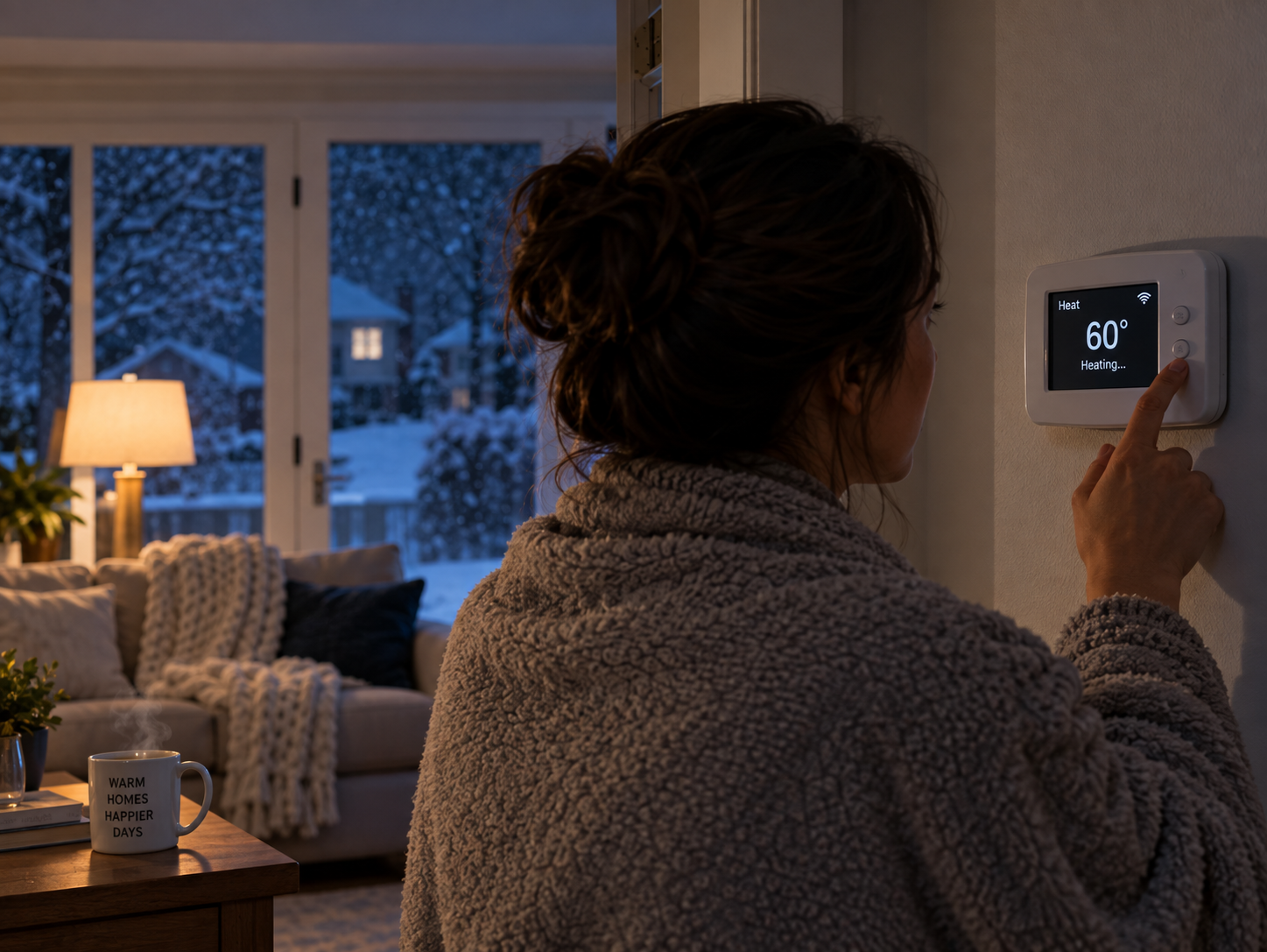
It is a little after two in the morning, the house is getting cold, and the heat is not running. This is one of the worst feelings a homeowner gets, and it happens more often in January than any other month. The U.S. Fire Administration found that residential building heating fire incidence "peaked in January at 20%" across its 2017 to 2019 study period, which tells you something about how hard heating equipment works in the middle of a Northeast winter.
There are a few things worth checking before you wake anyone up or call for service. Some of them solve the problem entirely. Others give a technician useful information and can shorten the visit.
There are also things you should absolutely not do, and we are going to be direct about those, because the difference between a cold night and a dangerous night is usually a decision someone made while tired and frustrated.
Cool As Ice HVAC has been handling no-heat calls in Norwalk and across Fairfield County for more than 30 years. We answer the phone at 2am. But we would rather you spend two minutes on a thermostat battery than pay for a service call you did not need, so here is the honest list.
Stop Right Here If Any of These Is True
Before any troubleshooting, read this section. If any of the following applies, stop reading, leave the building, and call for help from outside.
- Your carbon monoxide alarm is sounding. Get everyone out to fresh air immediately, then call 911. The U.S. Consumer Product Safety Commission's instruction is exactly that: "If you suspect CO poisoning, get outside to fresh air immediately, and then call 911." Do not look for the source. Do not open the furnace. Do not silence the alarm and go back to bed.
- You smell gas, propane, or fuel oil. Leave the building. Do not flip light switches, do not use the garage door opener, do not light anything. From outside, call 911 or your utility's emergency line and follow their instructions.
- Anyone in the house has symptoms of CO exposure. CPSC lists these as "headache, dizziness, weakness, nausea, vomiting, sleepiness, and confusion." Several people or pets feeling unwell at the same time, especially if it improves outdoors, is a serious warning sign. Get everyone out and call 911.
- You see smoke, flames, or scorching, or smell something burning. Get out and call 911.
- There is water pouring from the equipment or flooding around it. Keep away from any standing water near electrical equipment and call for service.
These are not situations to troubleshoot. The numbers are not abstract: CPSC reports that "more than 200 people in the United States die every year from accidental non-fire related CO poisoning associated with consumer products," and CDC data (MMWR QuickStats, covering 1999 through 2010) put unintentional, non-fire-related CO poisoning at "an average of 430 deaths per year" in the United States.
Nothing about a cold house is worth that risk. Get out first. The heating problem will still be there in an hour.
CALL TO ACTION
Once everyone is safe and emergency services have cleared the situation, we can take it from there. We run emergency service 24/7. Call Rudy directly at (203) 515-1141 or fill out our contact form to schedule.
Check One: The Thermostat
Start here, because it is safe, it is fast, and it is genuinely one of the most common causes of a no-heat call.
- Is it set to Heat? Obvious, but worth confirming. Thermostats get bumped, and someone else in the house may have changed it.
- Is the setpoint above the current room temperature? It needs to be several degrees higher to reliably trigger a call for heat.
- Is the display on at all? A blank screen usually means dead batteries or a loss of power to the thermostat.
- Does it take batteries? Many do, including some that appear to be hardwired. Fresh batteries are a two-minute fix and solve a surprising number of no-heat calls.
- Is a schedule or hold overriding you? Programmable and smart thermostats can be running a setback schedule, a vacation mode, or a geofencing rule that someone set up months ago.
- Did it lose its Wi-Fi or app connection? Some smart thermostats behave unexpectedly after an update or a router change.
- Is it in the right mode for the season? "Auto" versus "Heat" behaves differently on different models.
If you have a multi-zone system, check every thermostat, not just the one in the room you are standing in. A failed zone thermostat or zone valve can leave one part of the house cold while the rest is fine.
Check Two: The Service Switch
Most heating systems have a switch that cuts power to the equipment. It usually looks exactly like an ordinary light switch, often with a red cover plate, and it is mounted at the top of the basement stairs, on a joist near the equipment, or on the side of the unit itself.
It gets switched off by accident more than you would think. Someone carrying laundry, a contractor working in the basement, a child, or a guest looking for a light. If your system went from working to completely dead with no warning, look at this switch before anything else.
Make sure it is on. If it was off, turn it on and give the system several minutes to go through its startup sequence.
Check Three: The Breaker
Go to your electrical panel and look for the breaker labeled for the furnace, boiler, or air handler. On some systems there are two: one for the indoor unit and one for an outdoor unit.
A tripped breaker usually sits in a middle position rather than fully on or fully off. To reset it, push it firmly all the way to off first, then back to on.
Reset it once. If it trips again, stop. A breaker that trips repeatedly is telling you there is an electrical fault, and that is exactly what the breaker is there for. Repeatedly resetting it removes your protection against the thing it is protecting you from. Leave it off and call for service.
If your home has fuses rather than breakers, and you are not comfortable working at the panel, that is a fine reason to simply call.
Check Four: The Air Filter
On a forced-air system, a badly clogged filter restricts airflow. When airflow drops far enough, a furnace can overheat and shut down on a high-limit safety control. That is the safety working correctly, but it presents to you as no heat.
Pull the filter out and hold it up to a light. If you cannot see light through it, it is too dirty. Replace it with the same size, with the arrow pointing toward the blower, and give the equipment time to cool and restart.
ENERGY STAR's guidance is to check the filter monthly during heavy use, and "if the filter looks dirty after a month, change it. At a minimum, change the filter every 3 months." A filter is one of the few pieces of HVAC maintenance a homeowner can genuinely handle alone, and keeping up with it prevents a meaningful share of winter service calls. Our maintenance visits catch the rest.
Check Five: Fuel Level
If you heat with oil or propane, check the tank gauge. Running out of fuel is a common and entirely fixable cause of no heat, and it is not something a technician can solve without a delivery.
A few notes:
- Oil tank gauges can stick. If the reading looks suspiciously like it has not moved in weeks, treat it with suspicion.
- Propane tanks have a percentage gauge under the dome lid.
- If you have run out of oil, the system will generally need to be restarted by a technician after delivery, and the fuel filter may need attention.
- If you heat with natural gas and other gas appliances in the house also are not working, the issue may be with the gas supply rather than your equipment. Call your utility.
Check Six: Vents, Registers, and Outdoor Terminations
Inside, walk the house and make sure supply registers are open and not blocked by furniture, rugs, or boxes. Make sure return grilles are clear too. This will not usually cause a complete no-heat situation, but it causes plenty of "one room is freezing" calls.
Outside, if you have a high-efficiency furnace or boiler, it vents through PVC pipes that exit through a sidewall, often low to the ground. During and after a snowstorm, those terminations can get buried by drifting or by snow thrown from a plow or snowblower. Blocked intake or exhaust will shut the equipment down on a safety.
If you can reach them safely from the ground, clear snow and ice away from the outside of those pipes and keep a clear area around them. Do not climb, do not reach into the pipe, and do not do this if conditions are unsafe. The same goes for keeping the area around an outdoor heat pump unit clear of snow.
If you have an older system with a metal chimney or flue, do not attempt to inspect or clear it yourself. That is a job for a professional.
What Not to Do, No Matter How Cold It Is
This is the most important list in this article. Every item here is something we have seen homeowners attempt, and every one of them can turn an inconvenience into an emergency.
- Do not open sealed combustion chambers or burner compartments. Panels on fuel-burning equipment are sealed for a reason. Opening them can disrupt venting and combustion and expose you to hazards you cannot see.
- Do not touch, tighten, loosen, or adjust gas lines, gas valves, or fuel piping. Ever. Not to check a connection, not to "just make sure." This is licensed work.
- Do not bypass, jumper, tape down, or defeat any safety switch, limit, rollout switch, pressure switch, or flame sensor. Those devices shut the equipment down because a condition exists that makes running it unsafe. Getting around them does not fix the condition; it just removes the protection.
- Do not repeatedly reset the unit. One reset is reasonable. Repeated resets on oil-fired equipment can pump unburned fuel into the chamber and create a serious hazard. Repeated resets on any equipment mean you are overriding a fault rather than fixing it.
- Do not reset a breaker more than once if it keeps tripping.
- Do not use an oven, range, stovetop, or outdoor grill to heat the house. This is one of the most common paths to carbon monoxide poisoning.
- Do not run a generator indoors, in a garage, in a basement, or near open windows. CPSC guidance is to place portable generators outside, at least 20 feet away from the home, with exhaust directed away from the structure.
- Do not attempt repairs you found in a video on equipment that burns fuel or carries line voltage.
If your reaction to any of these is "but it is freezing," that is understandable and it is also exactly when people get hurt. Call us instead. We would rather drive out at 3am than read about what happened.
CALL TO ACTION
If you have been through the safe checks and still have no heat, stop there and let us handle it. Call Rudy directly at (203) 515-1141 or fill out our contact form to schedule.
A Word About Resetting
Many furnaces and boilers have a reset button, and many homeowners have learned that pressing it sometimes brings the system back.
Here is the right way to think about it. A lockout is the equipment reporting that something went wrong during a start attempt. Pressing reset tells it to try again. Trying once is reasonable, because transient faults do happen.
If it locks out again, that is not a glitch. It is a repeated, reproducible failure, and the equipment is doing its job by refusing to keep trying. On oil-fired systems in particular, repeated resets can deliver unburned oil into the combustion chamber, which creates a real risk when the unit eventually does fire.
Reset once. If it fails again, leave it off and call. Our service and repair team deals with lockout faults constantly, and the fault code the unit is showing usually tells us a great deal before we even arrive.
Protecting the House While You Wait
If heat is going to be off for a while during genuinely cold weather, there are a few sensible things to do. For reference, the ENERGY STAR County-Level Design Temperature Reference Guide (2015) lists a 99% heating design temperature of 9°F for Fairfield County, so a serious cold night here is cold enough to matter for plumbing.
- Open cabinet doors under kitchen and bathroom sinks so warmer room air reaches the pipes, especially on exterior walls.
- Let faucets on vulnerable runs drip slightly. Moving water is harder to freeze.
- Close off unused rooms to concentrate whatever warmth remains.
- Close blinds and curtains to slow heat loss through glass.
- Put down draft stoppers at exterior doors.
- Gather everyone into one or two rooms rather than heating the whole house.
- Dress in layers and use blankets. Body heat in a small closed room goes a long way.
- If you know where your main water shutoff is, make sure you can reach it.
If you use a portable space heater, keep at least three feet of clearance around it, plug it directly into a wall outlet rather than an extension cord or power strip, place it on a hard level surface, and never leave it running unattended or while sleeping. The U.S. Fire Administration reported an estimated annual average of 34,200 heating fires in residential buildings causing 165 deaths, 600 injuries, and $367 million in property loss during 2017 to 2019, and found heating to be "the second leading cause of all residential building fires, following cooking."
If it is severely cold and you cannot keep the house safe, going to family, friends, or a local warming center is a completely reasonable decision.
When to Stop Checking and Call
Call for service, rather than continuing to troubleshoot, when:
- You have gone through the thermostat, service switch, breaker, filter, and fuel checks with no change.
- The equipment starts and then shuts down within a minute or two, repeatedly.
- The breaker trips again after one reset.
- The unit locks out again after one reset.
- You hear grinding, screeching, banging, or repeated clicking with no ignition.
- There is water or oil where it should not be.
- The system has been unreliable and this is the latest in a series.
- Anything about the situation makes you uneasy. That instinct is worth listening to.
We provide emergency HVAC service around the clock for exactly this. There is no benefit to sitting in a cold house until morning hoping something changes.
What to Tell Us When You Call
The more you can tell us, the faster we can help, and sometimes we can talk you through something simple on the phone. Useful details:
- What kind of system you have, if you know: furnace, boiler, heat pump, and what fuel it uses.
- Whether the equipment is doing anything at all: silent, humming, clicking, starting and stopping.
- Any error code, blinking light pattern, or message on the equipment or the thermostat.
- What you have already checked, so we do not repeat it.
- When it last worked normally and whether anything changed around then.
- Whether it is the whole house or one zone.
- Whether there has been any recent work in the house.
- How cold it is inside, and whether anyone in the home is elderly, very young, or medically vulnerable.
That last one matters. Tell us. It affects how we prioritize the call.
What This Is Usually Not
One more thing, because it comes up every winter. A no-heat call is not automatically a dead system.
The most common causes we find on emergency calls are small: a thermostat with dead batteries, a switch someone turned off, a clogged filter, a tripped breaker, an empty oil tank, a blocked vent termination, a failed igniter, a dirty flame sensor, a stuck zone valve, a bad thermocouple, a clogged condensate line on a high-efficiency unit. Most of these are ordinary repairs.
Nobody should be telling you at 3am in a cold house that you need a whole new system. That is a decision to make in daylight with the numbers in front of you, not under pressure. If we come out and the equipment genuinely is finished, we will say so plainly and we will get you through the night first. But our first job is to get your heat back on, and most of the time that is exactly what happens.
If you are curious about how we approach that decision generally, our heating systems page and our FAQs cover it in more detail.
Frequently Asked Questions
Why did my furnace stop working in the middle of the night?
Overnight is when heating systems work hardest, because outdoor temperatures are lowest and thermostats often come out of a setback. Common causes include a tripped safety control from restricted airflow, a clogged filter, an ignition component failure, a blocked vent termination after snowfall, a thermostat battery that finally died, or simply running out of fuel. Most are ordinary repairs.
Is it safe to keep pressing the reset button?
No. Press it once. If the system locks out again, leave it alone and call for service. A repeated lockout means a real fault is present, and on oil-fired equipment repeated resets can push unburned fuel into the combustion chamber, which creates a genuine hazard when the unit finally ignites.
What should I do if I smell gas?
Leave the building immediately. Do not operate light switches, appliances, or anything that could create a spark, and do not try to find the leak. From outside the house, call 911 or your gas utility's emergency number and follow their instructions. Do not go back inside until they tell you it is safe.
My carbon monoxide alarm went off but I feel fine. Can I just reset it?
No. Follow CPSC guidance: get everyone outside to fresh air immediately, then call 911. Carbon monoxide is odorless and colorless, and you cannot judge exposure by how you feel. The alarm exists precisely because your senses cannot detect it. Have the situation cleared by emergency responders before anyone re-enters or any equipment is inspected.
Can a dirty filter really shut down my furnace?
Yes. A heavily clogged filter restricts airflow across the heat exchanger, which can cause the furnace to overheat and shut down on a high-limit safety control. Replacing the filter and allowing the unit to cool sometimes restores operation. If it shuts down again with a clean filter, there is another airflow or control problem that needs diagnosis.
Should I turn the thermostat way up to heat the house faster?
No. Most heating systems deliver heat at one rate regardless of the setpoint, so setting it to 85 does not warm the house faster. It just means the system runs past the temperature you actually wanted and you have to remember to turn it back down.
Do you really answer the phone at night?
Yes. Our office hours are Monday through Friday 7am to 6pm and Saturday 8am to 4pm, and we provide emergency service 24/7 for no-heat situations across Fairfield County and our Westchester County service area. If it is an emergency, call rather than waiting for morning.
CALL TO ACTION
No heat right now? Do not sit in a cold house waiting for morning. Call Rudy directly at (203) 515-1141 or fill out our contact form to schedule.
About Cool As Ice HVAC
Cool As Ice HVAC is a family-owned heating and cooling company based in Norwalk, Connecticut, with more than 30 years of experience serving local homeowners and businesses.
- Office: (203) 515-7693
- Rudy Jimenez, head mechanic, direct: (203) 515-1141
- Hours: Monday through Friday, 7am to 6pm; Saturday, 8am to 4pm
- Emergency service: available 24/7
We serve Fairfield County, including Norwalk, Stamford, Greenwich, Darien, New Canaan, Westport, Fairfield, Wilton, Weston, Ridgefield, and Trumbull, along with select communities in Westchester County, New York, including Rye, Armonk, Bedford, and Pound Ridge. See our service areas page for the full list, or read more about our family business.