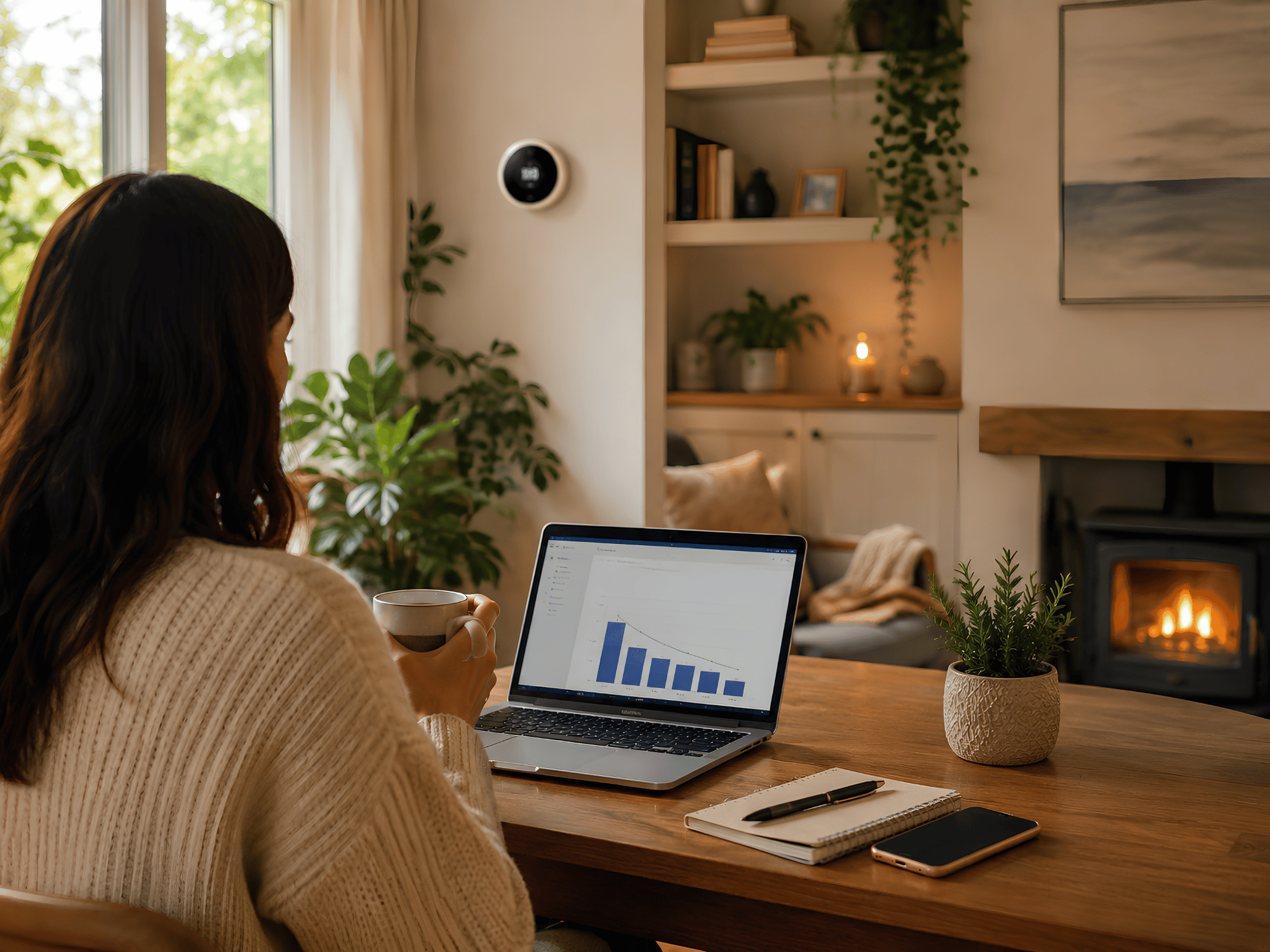
Winters in Fairfield County can put your heating system to work.
When temperatures drop, furnaces, boilers, heat pumps, and hydronic systems may run for long stretches to keep homes comfortable. That makes winter one of the first times homeowners notice problems such as rising utility bills, uneven temperatures, longer heating cycles, or equipment that seems to work much harder than it did in previous years.
The good news is that lowering your heating bill does not always require replacing your entire HVAC system.
Several relatively simple changes can reduce unnecessary energy use while helping your existing equipment operate more effectively.
And when a heating bill suddenly increases for no clear reason, it may also be your home's way of telling you that the system needs professional attention.
If you already suspect a problem, explore our heating services or schedule HVAC service.
Start by Understanding Why Heating Costs Increase
There are two sides to every heating bill: how much energy costs and how much energy your home uses.
You cannot control every change in utility or fuel prices, but you can influence the amount of energy your home needs to stay comfortable.
Weather plays a major role. A colder winter naturally requires more heating. But your thermostat settings, HVAC maintenance, air filters, ductwork, insulation, air leaks, equipment condition, and daily habits all influence the amount of energy your home consumes.
That is why the best strategy is not a single trick. It is eliminating small sources of wasted energy throughout the home while keeping the heating system operating properly.
1. Use Your Thermostat More Strategically
You do not need the exact same indoor temperature 24 hours a day.
If everyone is sleeping or the house is empty for several hours, lowering the thermostat can reduce unnecessary heating.
The U.S. Department of Energy says homeowners can save as much as approximately 10% per year on heating by turning the thermostat back 7 to 10 degrees for eight hours per day, although actual results vary by home, system, weather, and usage.
The key is consistency.
A programmable or smart thermostat can automatically follow a schedule so you do not have to remember to change the temperature every morning and evening.
That does not mean repeatedly turning the heat off or making extreme temperature changes. The right settings depend on your HVAC equipment and your household.
If you have a heat pump or a more specialized heating configuration, ask your HVAC technician about the best thermostat strategy for your system.
2. Check Your HVAC Filter Regularly
This may be the simplest heating tip on the entire list.
A dirty filter makes it harder for a forced-air HVAC system to move air properly.
When airflow is restricted, the heating equipment may need to work harder to maintain the temperature you want.
ENERGY STAR recommends checking HVAC filters monthly, particularly during heavy-use winter and summer periods, and replacing dirty filters. As a general minimum, ENERGY STAR recommends changing them at least every three months.
Your actual replacement schedule can vary based on the filter, system, pets, household conditions, renovations, and indoor air quality needs.
If you are unsure which filter belongs in your equipment, ask during your next HVAC maintenance visit.
3. Schedule Heating Maintenance Before You Have a Problem
Preventative HVAC maintenance is one of the most important steps you can take before winter gets serious.
A furnace, boiler, heat pump, or hydronic system can continue operating even when something is not quite right. You may not notice a developing issue until energy consumption increases, rooms become uncomfortable, or the equipment stops working.
A professional heating tune-up gives a technician an opportunity to inspect the system, review its operation, clean or service appropriate components, and identify issues that deserve attention.
The Department of Energy recommends professional preventative HVAC checkups and specifically advises having furnaces inspected before the heating season.
For local homeowners, that means scheduling heating and HVAC maintenance before the first prolonged stretch of freezing weather whenever possible.
4. Don't Block Supply or Return Vents
Take a quick walk through your home and look at every supply and return vent.
Furniture, rugs, curtains, boxes, and other household items can unintentionally restrict airflow.
Closing multiple vents in unused rooms is also not always the energy-saving shortcut people expect. HVAC systems are designed around specific airflow requirements, and dramatically changing that airflow can create other problems.
If you have rooms that are consistently too warm while others remain cold, do not simply close every vent in the warmer rooms.
Uneven temperatures can be related to ductwork, system balancing, insulation, zoning, equipment sizing, or other factors.
Persistent hot-and-cold spots are worth discussing with an HVAC professional.
5. Stop Heated Air From Escaping
Your heating equipment may be doing its job perfectly while your house is losing heat somewhere else.
Common air-leak areas include windows, exterior doors, attic access points, penetrations around pipes and wiring, and other openings in the building envelope.
Weatherstripping and appropriate sealing can help reduce drafts and keep conditioned air inside.
Insulation is equally important, particularly in attic spaces.
When warm indoor air escapes faster than necessary, your HVAC system has to replace that heat repeatedly. Reducing those losses can improve comfort while lowering the workload placed on your heating equipment.
If your furnace seems to run constantly but reaches the correct temperature only slowly, consider both the HVAC system and the home itself.
6. Have Ductwork Evaluated When Comfort Problems Persist
In a forced-air system, the ductwork is responsible for delivering heated air throughout the house.
Leaks, poor insulation, damaged sections, design issues, or disconnected ducts can waste conditioned air before it reaches the rooms you are trying to heat.
This is particularly relevant in older Fairfield County homes that have been renovated or expanded over time.
Additions and remodeled spaces sometimes create HVAC challenges when existing ductwork was not originally designed to serve the new layout.
If certain areas never seem comfortable, a professional HVAC evaluation can help determine whether the problem begins with the heating equipment or the distribution system.
7. Use Free Solar Heat When It Helps
Some of the simplest energy-saving strategies do not involve HVAC equipment at all.
On sunny winter days, opening curtains or shades on windows receiving direct sunlight can provide a little natural heat.
Closing window coverings again when sunlight disappears can help reduce the chilly feeling around cold glass.
The Department of Energy includes using sunlight through south-facing windows during winter among its basic home energy recommendations.
It will not replace your furnace or boiler, but small improvements can add up over an entire heating season.
8. Pay Attention to Your Boiler or Hydronic Heating System
Not every Fairfield County home uses forced-air heating.
Boilers and hydronic systems are common throughout the region, particularly in older homes.
If you have radiators, baseboard heating, radiant zones, or another hydronic setup, proper system operation matters just as much as furnace maintenance.
Watch for rooms that heat inconsistently, unusual boiler sounds, slow heating response, leaking components, or sections of the home that never reach the thermostat setting.
Boilers include controls, pumps, valves, piping, and other components that must work together.
If something seems different from previous winters, have it checked rather than assuming high heating costs are simply the price of cold weather.
Cool As Ice provides heating service for furnaces, boilers, hydronic systems, and other home heating equipment.
9. Don't Wait on Small Heating Repairs
Small problems rarely become less expensive because they were ignored.
Maybe your furnace occasionally fails to start on the first attempt. Perhaps the boiler has developed a new noise. One room suddenly takes much longer to warm up. The thermostat behaves strangely. Your heating system seems to cycle differently.
These may or may not be serious problems.
But waiting until the system stops entirely can turn a normal service appointment into an emergency call during the coldest part of the winter.
Our HVAC repair services are designed to diagnose heating and cooling problems so you understand what needs attention.
If you completely lose heat, visit our emergency HVAC service page.
10. Consider Whether Older Equipment Is Still Economical to Operate
An older heating system is not automatically a bad heating system.
Many well-maintained furnaces and boilers continue operating reliably for years.
However, age becomes increasingly relevant when an older system is also experiencing frequent repairs, high operating costs, uneven comfort, or declining performance.
At that point, ask your HVAC contractor to compare the condition of the existing equipment with available replacement options.
Do not focus only on the sticker price of new equipment.
Consider expected operating costs, reliability, home comfort, repair history, system sizing, and how long you plan to remain in the property.
Our residential HVAC team can help evaluate those factors when you are considering a heating system upgrade.
11. Make Sure New Equipment Is Properly Sized
Bigger does not automatically mean better in HVAC.
Heating equipment that is too large for the home can create performance issues just as equipment that is too small can struggle to maintain comfort.
ENERGY STAR recommends HVAC sizing based on the actual characteristics of the home rather than a rough rule of thumb and notes that oversized equipment can cycle too frequently.
Proper sizing should consider more than square footage.
The home's insulation, windows, orientation, layout, air leakage, construction, and other factors can affect heating requirements.
This becomes especially important in renovated Fairfield County properties where the current home may be very different from the house that existed when the original HVAC equipment was installed.
12. Treat a Sudden Heating-Bill Increase as a Clue
If your household habits have not changed and the weather is comparable, a sudden unexplained increase in heating costs deserves attention.
There may be a simple explanation.
Maybe the filter is overdue. Perhaps thermostat schedules changed. Maybe a door is not sealing correctly.
But an unexpected increase can also accompany HVAC performance problems.
Instead of immediately assuming you need new equipment, start with an inspection.
A professional can evaluate whether the heating system appears to be operating normally and identify any obvious problems that should be corrected.
Heating Efficiency Starts With the Whole Home
One of the biggest misconceptions about high heating bills is that the furnace or boiler must be the only problem.
Your heating system is part of a larger system.
The thermostat tells it when to run. The equipment produces heat. Ductwork, piping, radiators, or other distribution components move that heat throughout the home. Insulation and air sealing help keep it there.
A weakness anywhere in that chain can affect both comfort and energy use.
That is why improving heating efficiency usually requires looking at the complete picture rather than simply replacing one component.
Heating Fairfield County Homes Is Not One-Size-Fits-All
Norwalk, Stamford, Greenwich, Darien, New Canaan, and the surrounding Fairfield County communities include an enormous range of home styles and HVAC systems.
Some houses use gas furnaces.
Others rely on boilers and hydronic heat.
Others use heat pumps, multi-zone systems, ductless equipment, or combinations that have developed through years of renovations.
That variety is exactly why local experience matters.
Cool As Ice provides HVAC service throughout Fairfield County, with heating solutions based on the actual equipment and layout in your home.
What Temperature Should I Set My Thermostat to in Winter?
There is no single perfect thermostat setting for every household.
Comfort preferences, insulation, HVAC type, occupancy, and health considerations all matter.
From an energy standpoint, lowering the thermostat during extended periods when the home does not need to be as warm can reduce heating consumption. Automated thermostat schedules make that easier.
If you use a heat pump or specialized system, ask your HVAC contractor how aggressive setbacks may affect your particular equipment.
How Often Should I Replace My Furnace Filter?
ENERGY STAR recommends checking the filter every month during high-use periods and changing it whenever it is dirty, with every three months serving as a general minimum guideline.
Some homes need filter changes more frequently.
Always follow the requirements for your particular HVAC equipment and filter.
Does HVAC Maintenance Really Help Lower Heating Costs?
Proper maintenance can help your heating equipment operate as intended while identifying problems that may negatively affect performance.
It can also catch developing issues before they become emergency repairs.
Maintenance cannot eliminate every heating expense or guarantee a specific savings amount, but it is an important part of efficient HVAC operation.
Why Is My Heating Bill High Even With a New Furnace?
New equipment cannot compensate for every problem elsewhere in the house.
Duct leakage, poor insulation, air leaks, thermostat settings, extreme weather, zoning issues, installation problems, or other factors can still increase energy consumption.
If a relatively new furnace is producing unexpectedly high bills, have both the equipment and surrounding HVAC system evaluated.
When Should I Call an HVAC Company About High Heating Bills?
Call when a sudden increase is accompanied by changes in system behavior.
That might include unusual sounds, inconsistent temperatures, unexpectedly long run times, frequent cycling, weak airflow, ignition problems, or rooms that no longer heat normally.
Those symptoms give your HVAC technician additional clues about what may be happening.
Ready to Make Your Home More Comfortable This Winter?
You should not have to choose between staying comfortable and wondering whether your heating system is wasting energy.
Start with the basics: smart thermostat use, clean filters, sensible air sealing, open airflow pathways, and routine HVAC maintenance.
If your furnace, boiler, hydronic system, or heat pump still seems to be working too hard, let a professional take a look.
Explore our heating services, learn more about HVAC maintenance, or schedule heating service with Cool As Ice.
A properly cared-for system can make a Fairfield County winter feel a whole lot more comfortable.