
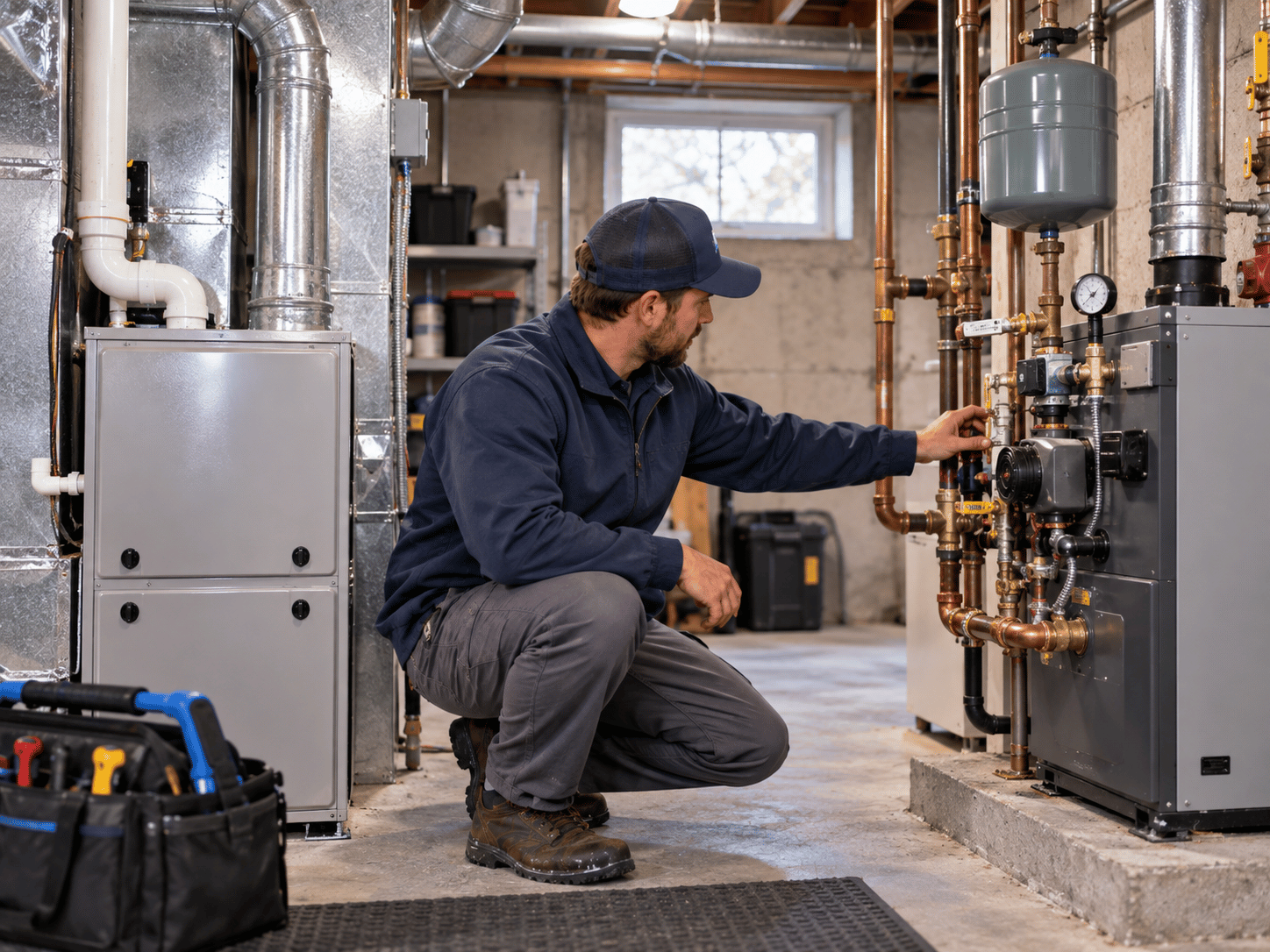
A good number of the service calls we take start with a homeowner apologizing. They are not sure what to call the thing in the basement. They say furnace, and then they say boiler, and then they say "the heating thing," and they feel a little embarrassed about it.
Nobody should. Plenty of people live in a house for fifteen years without ever needing to know the difference, and there is no reason the distinction should be common knowledge. But it does matter, and not in a trivia way. What kind of heating system you have shapes what your repairs cost, what your options are when it finally does need replacing, whether central air conditioning is realistic in your house, how your home feels room to room, and what a contractor can honestly recommend to you.
Cool As Ice has been working on heating equipment in Norwalk and across Fairfield County for more than 30 years. We service furnaces, boilers, steam systems, heat pumps and everything in between. This article is meant to let you figure out what you have, understand why it is there, and know what that means for the decisions ahead of you.
The Difference, in One Paragraph
A furnace heats air. It burns fuel or uses electric elements to warm air, then a blower pushes that warm air through ductwork to registers in each room. A boiler heats water. It warms water or produces steam, then circulators or pressure move that water through pipes to radiators, baseboard convectors, or tubing in the floor, and the heat radiates out into the room from there.
That is the whole distinction. Air versus water. Everything else follows from it.
A furnace-heated house is a house with vents and ducts. A boiler-heated house is a house with radiators, baseboard units, or warm floors, and pipes instead of ducts. Once you know which one you are looking at, a lot of other things start making sense.
CALL TO ACTION
Not sure what you have, or whether it is running the way it should? We will identify it, evaluate it, and explain it in plain language. Book a 45-minute appointment, contact us, or call Rudy directly at (203) 515-1141.
How to Tell Which One You Have
You can usually settle this in about ninety seconds without touching anything.
Look at the rooms first.
- If you see rectangular metal grilles in the floors, walls or ceilings that blow air when the heat runs, you have forced air. That means a furnace, an air handler, or a heat pump.
- If you see cast iron radiators, or low metal enclosures running along the baseboard with fins inside, or you have warm floors with no visible emitters at all, you have hydronic heat from a boiler.
- If you see electric baseboard units that heat up with no pipes attached and no central equipment involved, that is electric resistance heat and there is no furnace or boiler in the picture at all.
Then look at the equipment.
- A furnace typically has a large sheet metal plenum on top with big rectangular ducts branching off it, and a filter slot somewhere near the bottom or side.
- A boiler has copper or black iron pipes coming out of it, usually several, along with a circulator pump or two, a pressure gauge, and an expansion tank nearby. Often there is a domestic hot water connection as well.
- A steam boiler will be larger and heavier-looking, with a sight glass on the side showing a water level, and a single large pipe heading up out of the top.
If you still cannot tell, take a photo and we will tell you over the phone. We do that all the time and nobody gets charged for it.
What Fairfield County Homes Actually Have
Our part of Connecticut is unusually mixed, and it is worth understanding why.
Statewide, U.S. Census Bureau American Community Survey data for 2024 found that 36 percent of Connecticut households heat with utility gas, 35 percent rely on heating oil, and 20 percent heat primarily with electricity. That is a genuinely split market, and it is very different from much of the country.
In Fairfield County specifically, the pattern is shaped by two things: housing age and gas main coverage.
A great deal of our housing stock predates the widespread use of forced-air residential heating. Colonials and farmhouses in Wilton, Weston, Ridgefield and New Canaan were frequently built with hydronic heat or converted to it early, and those cast iron radiators are still doing their job a century later. Postwar development in Norwalk, Trumbull, Fairfield and parts of Stamford brought more forced air, especially in ranches and split-levels built in the 1950s and 1960s. Newer construction and major renovations across Darien, Westport and Greenwich tend toward forced air because it makes central air conditioning straightforward.
Gas availability is the other factor, and it is very local. Natural gas mains run down some streets and not others, sometimes within the same neighborhood. A house a quarter mile off a main may never have had a practical path to gas, which is why oil-fired boilers remain common in outlying areas of Wilton, Weston and Ridgefield, and in the Westchester communities we serve like Bedford, Armonk and Pound Ridge. Propane fills some of the gaps.
So the honest picture is that there is no typical Fairfield County heating system. We show up to a 1920s oil boiler in Westport on Tuesday and a 2019 high-efficiency gas furnace in Stamford on Wednesday.
Forced Air: What It Does Well and Where It Struggles
Forced air systems heat quickly. Turn the thermostat up and you feel warm air within a minute or two. They also give you a single distribution system that can serve both heating and cooling, which is why central air is simple in a forced-air house and complicated in a hydronic one.
They also give you a path for filtration, humidification and ventilation equipment, since all the air in the house is already moving through one place.
Where they struggle:
- Duct losses. ENERGY STAR documents that roughly 20 to 30 percent of the air moving through a typical home's duct system is lost to "leaks, holes, and poorly connected ducts." That is a large number, and in houses where ducts run through unconditioned attics or crawlspaces, it is heat you paid for going straight outside.
- Uneven temperatures. Rooms far from the air handler often underperform. ENERGY STAR lists "rooms that are difficult to heat and cool" and "stuffy rooms that never seem to feel comfortable" as signs of a duct system that is not performing.
- Drafts and dryness. Moving air feels cooler on the skin, and heated air holds humidity differently, which is why furnace-heated homes often feel drier in January.
- Noise. A blower starting up is audible in a way that a radiator warming up is not.
None of these are fatal. All of them are addressable. But they are the complaints we hear.
Boilers and Hydronic Heat: What They Do Well and Where They Struggle
Hydronic heat is quiet, steady, and does not move dust around. Water carries heat far more effectively than air does, so the distribution pipes are small and the heat delivery is even. A lot of people who grew up with radiators prefer the feel of the heat, and that preference is not just nostalgia. Radiant surfaces warm objects and people rather than just the air, which reads as comfortable at a lower air temperature.
Zoning is also generally easier and cheaper with a boiler. Adding a zone means adding a circulator or zone valve and a thermostat, rather than reworking ductwork and dampers. That is why older homes with boilers often have three or four zones while a forced-air house of the same size has one.
Where boilers struggle:
- No cooling. A boiler cannot give you air conditioning. If you want cooling in a hydronic house, you need a separate system, which historically meant window units and now usually means ductless.
- Slower response. Heating a large mass of water and iron takes longer than heating air. Setback strategies that work well with forced air work less well with a heavy cast iron system.
- Water problems. Leaks, pressure issues, air trapped in the lines, failed circulators and corroded pipes are all boiler-specific failure modes, and water in a basement causes more damage than air does.
- No built-in filtration. There is no central air stream to filter, which is neutral for some people and a drawback for allergy sufferers.
We cover both types under heating systems, and in most older homes the boiler is also making your domestic hot water, which ties into hot water systems as well.
Steam: The Ones That Are Really Old
A small but real number of homes in Norwalk, Stamford, Bridgeport-adjacent areas and older parts of Fairfield still run on steam. These are one-pipe or two-pipe systems where the boiler actually boils water and steam rises through the pipes to the radiators under its own pressure.
Steam systems have their own vocabulary and their own failure modes: air vents, main vents, pitch of the radiators, water line, low-water cutoffs, banging pipes from trapped condensate. They also last a remarkably long time when maintained.
Here is the important thing, and we will say it plainly: a steam system is not automatically a candidate for replacement because it is old. We have seen homeowners told to rip out a functioning steam system that had decades left in it. Often the real problem was a $40 air vent, a pitch adjustment, or a water level control that needed attention. Get a second opinion before you let anyone convert a steam house.
CALL TO ACTION
If someone has told you your boiler or steam system has to go, we are happy to take a second look before you commit to anything. Book a 45-minute appointment, contact us, or call Rudy directly at (203) 515-1141.
Efficiency Ratings, and What They Actually Mean
Both furnaces and boilers are rated in AFUE, or Annual Fuel Utilization Efficiency. It expresses roughly how much of the fuel energy ends up as usable heat over a season.
Current ENERGY STAR certification thresholds give you a sense of where the top of the market sits:
- Gas furnaces: 97% AFUE or greater in the U.S. North, 95% or greater in the U.S. South.
- Oil furnaces: 87% AFUE or greater, with UL 727 B20 certification.
- Gas boilers: 90% AFUE or greater.
- Oil boilers: 87% AFUE or greater.
ENERGY STAR also requires certified furnaces to have air leakage of 2.0 percent or less, and its boiler specification became effective in January 2024. ENERGY STAR estimates that a certified gas boiler will "save about $780 over the lifetime of the product" and a certified oil boiler will "save $200 over its lifetime" relative to standard models.
A few things worth noticing in those numbers. The gap between an ENERGY STAR gas boiler and the federal minimum is roughly 6 percentage points. The gap for oil boilers is about 1 point. That is why the lifetime savings estimate for oil boilers is so much smaller. Efficiency upgrades are not equally valuable across fuel types, and anyone presenting them as if they are is oversimplifying.
Also worth saying: AFUE describes the equipment, not the house. A 97% AFUE furnace attached to a duct system losing 25 percent of its air into an unconditioned attic is not delivering 97 percent of anything to your rooms. This is one of the more expensive misunderstandings in our trade, and it is why we look at distribution before we talk about equipment.
Why the Difference Matters for Air Conditioning
This is the single most practical consequence for most homeowners.
If you have a furnace, you already have ducts. Adding central air means adding an outdoor condenser and an evaporator coil, and you use the ductwork that is already there. It is a comparatively straightforward job.
If you have a boiler, there is no duct system to borrow. Your options are:
- Ductless mini-splits, which mount on the wall or ceiling and need only a small wall penetration for the refrigerant lines. This is by far the most common solution in older Fairfield County homes.
- A high-velocity small-duct system, which uses flexible small-diameter tubing that can be threaded through existing wall cavities. More invasive than ductless, less invasive than conventional ducts.
- A conventional ducted system, which usually means a major renovation with soffits, chases or an attic air handler.
We handle all three under cooling systems. In a house with radiators, the ductless route is usually the right answer, and a good side effect is that modern ductless heat pumps also provide heat, which gives you a second heat source for shoulder seasons and for rooms the boiler never quite satisfied.
Why It Matters for Repairs
Furnaces and boilers fail differently, and the repair experience is different.
Common furnace issues include ignition and flame sensing problems, blower motor and capacitor failures, limit switch trips from restricted airflow, control board faults, and heat exchanger concerns in older units.
Common boiler issues include circulator pump failures, zone valve problems, expansion tank issues, low water pressure, air trapped in the loops causing cold radiators, leaking fittings, and for oil systems, nozzle, electrode and fuel pump service.
Parts availability is a real factor in older equipment of both types. When a control board for a 22-year-old furnace is no longer manufactured, that changes the repair conversation honestly rather than as a sales tactic. We will tell you when parts are the constraint, and we will also tell you when they are not, which is more often than you might expect.
Our service and repair team works on both, and we stock common parts for the systems we see most in this area.
Why It Matters for Maintenance
The annual service is genuinely different and you should expect different things.
On a furnace, service typically involves the filter, blower assembly, burners and ignition, heat exchanger inspection, venting, safety controls, and verification that airflow and temperature rise are within the manufacturer's range.
On a boiler, service typically involves combustion and burner service, system pressure, expansion tank charge, circulators and zone valves, low-water cutoff, relief valve, venting, and bleeding air from the loops. Oil-fired equipment additionally needs nozzle replacement, electrode setting, filter changes and combustion analysis.
The Department of Energy notes that following recommended maintenance schedules "can help reduce your heating and cooling costs by 10% or more." That is not a dramatic number, but it compounds every year, and the bigger value is catching a small problem in October instead of a failure in January.
We do this work under HVAC maintenance, and we schedule heating service in the fall for exactly that reason.
Safety: Read This Part
Both furnaces and boilers that burn fuel produce combustion gases, and those gases have to leave the building through a properly functioning vent or chimney. That is the safety issue that matters most.
If you smell gas: leave the building immediately with everyone in it. Do not flip light switches, do not use your phone indoors, do not try to find the leak. From outside, call your gas utility's emergency number or 911, and follow whatever instructions they give you.
If a carbon monoxide alarm sounds: treat it as real every single time. The U.S. Consumer Product Safety Commission's guidance is unambiguous: "If you suspect CO poisoning, get outside to fresh air immediately, and then call 911." CPSC also reports that more than 200 people in the United States die each year from accidental non-fire carbon monoxide poisoning associated with consumer products. Do not open windows and go back to sleep. Do not reset the alarm. Get out, call, and have qualified people handle it.
Once the emergency responders have cleared the situation, a qualified technician should inspect the fuel-burning equipment before it is put back in service. That is what our emergency HVAC service is for, and we are available 24/7 for it.
Working carbon monoxide alarms on every level of the house are not optional in a home with combustion heating. They are cheap and they are the single best protection you have.
Repair or Replace? Age Alone Does Not Decide It
We want to be direct about this, because it is where homeowners get pushed around the most.
Age is one input. It is not the answer. A well-maintained 20-year-old cast iron boiler in a Ridgefield colonial may have years of reliable service ahead of it. A neglected 12-year-old furnace with a cracked heat exchanger needs to be dealt with now. Both of those are real situations we have walked into, and if you sorted them by age alone you would get both of them wrong.
The factors that actually matter:
- Condition of the major components. Heat exchanger, combustion chamber, and sections on a cast iron boiler.
- Repair history. One repair means nothing. A pattern of repairs means something.
- Parts availability. Can the thing be kept running at a reasonable cost.
- Safety. A confirmed heat exchanger crack or unsafe venting is not a wait-and-see item.
- How it performs for you. If the house is comfortable and the fuel bills are reasonable, that is evidence.
- Your plans for the house. Staying twenty years and staying two years lead to different answers.
A technician who recommends replacement should be able to point at specific findings. If the reasoning is "it is old," that is not reasoning. Get a second opinion. That advice costs us business sometimes and we give it anyway, because we have been in this community for three decades and reputation is the only marketing that has ever worked for us.
You can read more about how we work, check which towns we cover on our service areas page, or browse our FAQs. We also handle commercial HVAC for businesses and property managers throughout the county.
CALL TO ACTION
Whether you have a furnace, a boiler, or something you are not sure how to describe, we will look at it honestly and tell you what it actually needs. Book a 45-minute appointment, contact us, or call Rudy directly at (203) 515-1141.
Frequently Asked Questions
Is a boiler better than a furnace?
Neither is better in the abstract. Boilers deliver quiet, even, draft-free heat and zone easily. Furnaces heat quickly and share a distribution system with central air conditioning. What matters is which one your house was built for and how well it was installed. Converting from one to the other is a major project and is rarely justified by comfort preference alone.
How can I tell if my system is gas, oil or propane?
Look for the fuel source. An oil system has a tank, usually in the basement or buried outside, and a fuel line running to the burner. A propane system has an outdoor tank. A natural gas system has a gas meter outside and a black iron pipe running to the equipment with a shutoff valve. If you receive a delivery bill rather than a monthly utility bill, you are on oil or propane.
What AFUE should I look for in a new system?
ENERGY STAR certification currently requires 97% AFUE or greater for gas furnaces in the U.S. North, 87% or greater for oil furnaces, 90% or greater for gas boilers, and 87% or greater for oil boilers. Higher AFUE is not automatically the right purchase, though. Venting requirements, condensate handling, existing chimney condition and the state of your distribution system all affect what makes sense in a specific house.
Can I add central air to a house with a boiler?
Yes, but not by using the boiler. You need a separate cooling system. Ductless mini-splits are the most common solution in older Fairfield County homes because they need only a small wall penetration. High-velocity small-duct systems and conventional ducted systems are also options depending on the house and the budget.
Why are some of my radiators cold while others are hot?
On a hot water system, the usual causes are air trapped in the loop, a failed circulator or zone valve, a closed or stuck radiator valve, or a balancing issue. On a steam system, it is often a bad air vent, incorrect radiator pitch, or a main venting problem. Most of these are repairs, not replacements. It is worth having someone look before assuming the boiler is the problem.
How often should a furnace or boiler be serviced?
Annually, before the heating season. The Department of Energy notes that following recommended maintenance schedules can help reduce heating and cooling costs by 10 percent or more, and the larger benefit is catching developing problems while you still have options. Oil-fired equipment in particular needs yearly attention to nozzles, filters and combustion settings.
Does my boiler also make my hot water?
In many older Fairfield County homes, yes. Boilers commonly produce domestic hot water through an internal tankless coil or an external indirect-fired storage tank. If your hot water disappears when the boiler has a problem, that is your answer. This is worth knowing because it affects what happens during a boiler replacement.
My heating system is 20 years old. Should I replace it?
Not on that basis alone. Age is one input among several, and condition, repair history, parts availability, safety findings and how the system actually performs matter more. Plenty of well-maintained 20-year-old boilers have useful life remaining. Ask any contractor recommending replacement to show you the specific findings behind the recommendation.
About Cool As Ice HVAC
Cool As Ice HVAC is a family-owned heating and cooling company based in Norwalk, Connecticut, with more than 30 years of local experience on furnaces, boilers, steam systems and heat pumps.
- Office: (203) 515-7693
- Rudy Jimenez, head mechanic, direct: (203) 515-1141
- Hours: Monday through Friday 7am to 6pm, Saturday 8am to 4pm, with emergency service available 24/7
- Service area: Fairfield County, including Norwalk, Stamford, Greenwich, Darien, New Canaan, Westport, Fairfield, Wilton, Weston, Ridgefield and Trumbull, plus select Westchester County, New York communities including Rye, Armonk, Bedford and Pound Ridge
We handle residential HVAC for homeowners across the region. Experienced service. Family-owned care. Comfort you can count on.