
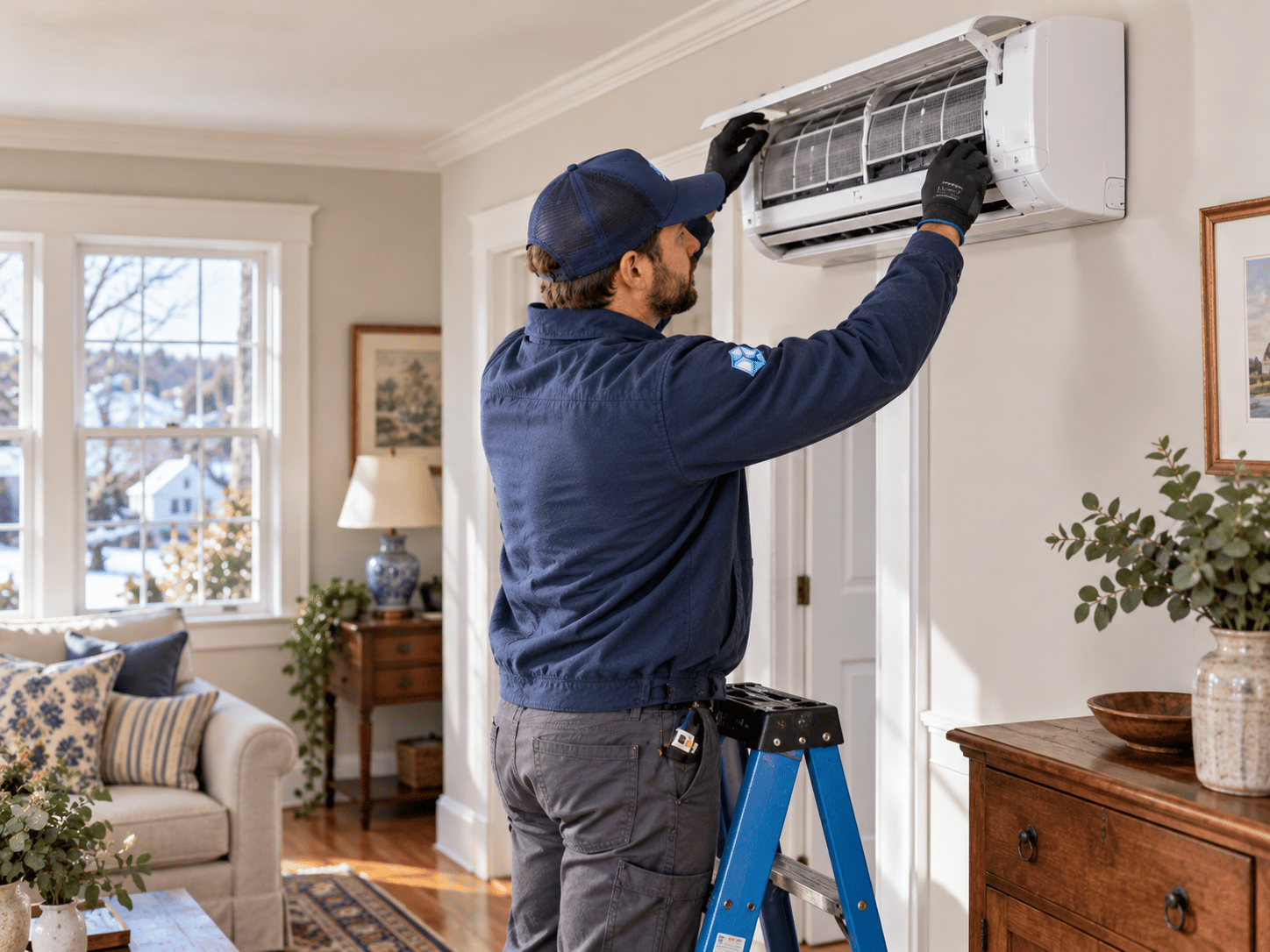
If your house has cast iron radiators or baseboard heat and no ductwork anywhere, you have probably been told at some point that central air conditioning is off the table. For a long time that was basically true. The options were window units, a major renovation, or living with it.
That has changed, and it changed enough that ductless mini-splits are now the single most common cooling solution we install in older Fairfield County homes. Houses in Westport, Wilton, Ridgefield, New Canaan and the older parts of Norwalk and Fairfield were built before forced air was standard, and they are exactly the houses these systems were designed for.
But we also want to be honest about them, because ductless has picked up a bit of a miracle reputation and it is not a miracle. It is a very good tool with real limitations, and it gets installed badly often enough that we get called to fix other people's work.
Cool As Ice has been installing and servicing heating and cooling equipment across Fairfield County for more than 30 years. Here is what you actually need to know.
What a Ductless Mini-Split Actually Is
A mini-split is a heat pump split into two pieces. An outdoor unit contains the compressor and a coil. One or more indoor units, usually called heads, contain a coil and a fan and sit inside the rooms you want to condition. Between them run refrigerant lines, a small electrical cable, and a condensate drain.
There is no ductwork. The indoor unit conditions the air in the room directly. That is the entire concept.
Because there are no ducts, the connection between outdoor and indoor equipment is small. The U.S. Department of Energy notes that ductless systems "require minimal construction as only a three-inch hole through the wall is required." That is the difference between a two-day install and a renovation.
And because it is a heat pump rather than an air conditioner, it runs in both directions. It cools in summer and heats in winter using the same equipment. A lot of homeowners buy one for cooling and end up using it for heat more than they expected.
CALL TO ACTION
Wondering whether ductless makes sense for your house and where the units would actually go? We will walk it with you and show you the options. Book a 45-minute appointment, contact us, or call Rudy directly at (203) 515-1141.
Why They Suit Old Connecticut Houses
ENERGY STAR identifies several situations where ductless systems are a good fit, and two of them describe most of our service area directly: "older homes with no existing ductwork (e.g., radiators or baseboard heat)" and "homes with costly electric heat (e.g., baseboard, furnace, wall heaters, electric radiant)." ENERGY STAR also lists additions and outbuildings "where extending ductwork is difficult," and spaces with "hot or cold spots" that need supplemental conditioning.
That covers a lot of ground here. Statewide, U.S. Census Bureau American Community Survey data for 2024 found 35 percent of Connecticut households heat with heating oil and 20 percent heat primarily with electricity. Oil-heated homes in this county overwhelmingly use boilers with radiators or baseboard, meaning no ducts. Electrically heated homes often use baseboard, also no ducts.
There is a second advantage that gets overlooked. Ductless systems have no duct losses at all, because there are no ducts. ENERGY STAR documents that in typical homes with ductwork, "about 20 to 30 percent of the air that moves through the duct system is lost due to leaks, holes, and poorly connected ducts." A ductless system starts from a position where that entire category of loss does not exist.
That is a real structural advantage, not marketing. It is one of the reasons ENERGY STAR's efficiency thresholds for certified non-ducted split-system heat pumps are actually higher than for ducted ones: at least 8.5 HSPF2 and 15.2 SEER2 for non-ducted, versus at least 8.1 HSPF2 and 15.2 SEER2 for ducted split systems.
Single-Zone and Multi-Zone Setups
There are two basic configurations, and the choice matters more than most homeowners realize.
A single-zone system pairs one outdoor unit with one indoor head. Simple, efficient, and independent. If it has a problem, only that room is affected.
A multi-zone system connects one outdoor unit to several indoor heads, often two to five. It saves outdoor space and usually costs less than the equivalent number of single-zone systems.
Multi-zone is more elegant on paper, but there is a real tradeoff. All the heads share one compressor. If only one small head is calling while the others are off, the outdoor unit may be running well below its efficient operating range. That is why a multi-zone system serving rooms with very different schedules sometimes underperforms its ratings.
There is also the resilience question. One outdoor unit serving five rooms means one failure affects five rooms. Two outdoor units serving the house in halves is more expensive and more robust.
We talk this through case by case. If a house in Darien wants cooling in two bedrooms that are used the same way at the same times, multi-zone is fine. If a house in Trumbull wants one head in a home office running all day and one in a guest room used four times a year, we might recommend separating them.
The Indoor Units Come in More Shapes Than You Think
The wall-mounted head high on the wall is the image everyone has, and a lot of homeowners hesitate because of how it looks. Worth knowing that it is not the only option.
- High wall units. The standard. Least expensive, easiest to install, most airflow options. Visible.
- Floor-mounted consoles. Sit low on the wall like a radiator. Often a better fit aesthetically in a room with radiators already, and useful under windows or in rooms with sloped ceilings where there is no good high wall.
- Ceiling cassettes. Recess into the ceiling with only a flat grille visible. Very discreet. Require a ceiling cavity, so they work in rooms with an attic or another floor above.
- Slim ducted air handlers. Hide in a closet, soffit or attic and serve two or three nearby rooms through short duct runs. This is an excellent option in a bedroom wing where you want the benefits of ductless equipment with no visible heads in the bedrooms.
That last one solves a great many aesthetic objections and homeowners often do not know it exists. In a Greenwich or New Canaan house where visible equipment is a genuine concern, a combination of ceiling cassettes and slim ducted units can make the whole system nearly invisible.
They Heat, Not Just Cool, and That Matters Here
The heating side is where these systems have changed the most.
The Department of Energy describes air-source heat pumps as able to "deliver up to three times more heat energy to a home than the electrical energy it consumes." That ratio drops as it gets colder, which is the reason cold climate certification exists.
ENERGY STAR's cold climate designation for air-source heat pumps requires the unit to demonstrate a coefficient of performance of at least 1.75 at 5°F, measured under the Appendix M1 H42 test, and a heating capacity at 5°F of at least 70 percent of its capacity at 47°F. ENERGY STAR also requires a controls verification procedure confirming the equipment's own controls deliver that performance in real operation.
Regionally, Northeast Energy Efficiency Partnerships maintains a cold climate air source heat pump product list for equipment suited to IECC climate zone 4 and higher, which includes Connecticut. NEEP's ccASHP Specification Version 4.0 took effect January 1, 2023.
If you are considering ductless partly for heat, ask specifically whether the model quoted carries cold climate designation. Not all mini-splits do, and the difference shows up in January, not July.
For efficiency comparison, ENERGY STAR states that certified mini splits "use up to 60% less energy than standard home electric radiators." If your house currently heats with electric baseboard, that is the most compelling case for ductless there is.
CALL TO ACTION
If you are heating with electric baseboard or paying for oil in rooms you barely use, a ductless head can change the math considerably. Book a 45-minute appointment, contact us, or call Rudy directly at (203) 515-1141.
What the Installation Actually Involves
Homeowners are usually surprised by how contained it is, and occasionally surprised by the parts nobody mentioned.
The work generally involves:
- Mounting the outdoor unit on a pad, wall bracket or stand, positioned above expected snow depth with room for defrost drainage and adequate clearance.
- Mounting each indoor head and cutting the wall penetration for the line set.
- Running refrigerant lines, control wiring and a condensate drain between the units.
- Concealing the line set, either inside walls or in an exterior line-hide cover.
- Running a dedicated electrical circuit to the outdoor unit, often requiring panel work.
- Evacuating the lines properly and verifying refrigerant charge.
- Commissioning, setting controls, and showing you how to run it.
A single-zone install is often one day. A multi-zone install is usually two or three.
Two things worth asking about before you sign anything:
Where does the line set run? Exterior line-hide is faster and cheaper but visible on the outside of the house. Running lines inside walls or through a basement is cleaner-looking and more work. On an older home with clapboard or shingle siding in Westport or Ridgefield, this is a conversation worth having up front rather than on install day.
Where does the condensate go? Each indoor head produces water in cooling mode. Gravity drainage to the outside is ideal. Where gravity does not work, a condensate pump is needed, and pumps make a small noise and can fail. Find out which you are getting.
The Honest Drawbacks
Every article about mini-splits lists the benefits. Here are the things we tell people in person.
- They are visible. A wall head is a piece of equipment on your wall. Cassettes and slim ducted units mitigate this at higher cost. If visual impact matters to you, say so early and we will design around it.
- They do not heat or cool rooms you did not put a head in. Air does not travel well around corners and up stairs. A head in the hallway will not condition the bedrooms. This is the single most common design mistake we are called to fix.
- Multi-zone efficiency is situational. As described above, a shared compressor serving heads with mismatched demand can run outside its best range.
- The outdoor unit has to go somewhere. It needs clearance, it is audible at close range, and in a tight urban lot in Stamford or Norwalk the siting question is real.
- Filters need regular attention. Each head has washable filters that need cleaning every few weeks during heavy use. A neglected head loses capacity and can develop odor problems.
- They are not a replacement for fixing a leaky house. Putting a head in a poorly insulated room over a garage is treating the symptom.
- Repair requires someone who knows them. Inverter-driven equipment has electronics that not every technician is comfortable diagnosing. Ask who will service it.
None of that is a reason to avoid ductless. It is a reason to design it properly. Our service and repair team works on these systems regularly, including systems other companies installed.
Sizing Is Where Most Systems Go Wrong
If we could get one message across about ductless, it would be this: bigger is not better, and oversizing is the most common mistake in the field.
An oversized head cools a room down quickly, shuts down or drops to minimum output, and stops removing humidity. In a Connecticut August that produces a room that is cold and clammy. It also causes the compressor to cycle more than it should, which costs efficiency and equipment life.
Proper sizing comes from a load calculation for the specific room, following ACCA Manual J principles, taking into account square footage, ceiling height, window area and orientation, insulation, exposure and how the room is used. A south-facing room with four large windows in Fairfield has a very different load than a north-facing interior bedroom of the same size.
Be wary of anyone who sizes from square footage alone using a rule of thumb. It is fast and it is frequently wrong.
Where ducted equipment is involved, such as a slim ducted air handler, airflow also matters. The Department of Energy's guidance calls for roughly 400 to 500 cubic feet per minute per ton, noting that "efficiency and performance deteriorate if airflow is much less than 350 cfm per ton." Short duct runs on a slim ducted unit are still duct runs and still need to be sized correctly.
Air Quality and Combustion
One point ENERGY STAR makes about ductless that is genuinely worth noting: "No combustion means better indoor air quality because there are no direct emissions such as NOx, carbon dioxide, or carbon monoxide."
That does not mean you can ignore combustion safety in your house. If you still have an oil or gas boiler making your heat and hot water, all the usual rules apply.
If you smell gas: leave the house with everyone in it, do not touch switches or use a phone indoors, and from outside call your gas utility's emergency number or 911. Do not try to locate the source.
If a carbon monoxide alarm sounds: get everyone outside. The U.S. Consumer Product Safety Commission's guidance is direct: "If you suspect CO poisoning, get outside to fresh air immediately, and then call 911." Have equipment inspected by a qualified technician only after emergency responders have handled the situation. Our emergency HVAC service is available 24/7 for the follow-up.
Maintenance
Ductless systems need less maintenance than ducted ones, but they are not maintenance-free, and neglected ones underperform badly.
What you should do:
- Clean the washable filters in each indoor head every two to four weeks during heavy use.
- Keep the outdoor unit clear of leaves, snow, mulch and shrubs.
- Watch for water dripping from an indoor head, which usually indicates a drain issue and should be addressed quickly.
- Note any new noises or a drop in output.
What we do annually:
- Deep clean the indoor coils and blower wheels, which accumulate biofilm over time in a way homeowner filter cleaning does not address.
- Clear and treat the condensate drain path.
- Verify refrigerant charge and check for leaks.
- Check electrical connections and controls.
- Clean the outdoor coil.
That blower wheel cleaning is the item people skip and it matters. A fouled blower wheel is the usual cause of a mini-split that develops a musty smell, and it is much easier to prevent than to remediate. We handle this under HVAC maintenance.
Cost and Incentives
We do not publish prices, because the honest answer depends on the number of heads, the indoor unit types, the line set routing, the electrical work and the house. We would rather look at it and give you a real number.
On incentives, two things as of this writing:
First, the federal Energy Efficient Home Improvement Credit under Section 25C is no longer available. ENERGY STAR describes those federal credits as having run "through December 31, 2025." Be skeptical of any quote that still includes one.
Second, Connecticut incentives do exist. Energize Connecticut, an initiative of the Connecticut Energy Efficiency Fund, the Connecticut Green Bank, the State and local utilities, lists a residential air source heat pump incentive of $250 per ton up to $2,500 in combined incentives for qualifying equipment, valid January 1 through December 31, 2026. Requirements include being a residential electric customer of Eversource or United Illuminating, using a participating contractor from the Energize CT Heat Pump Installer Network, and selecting equipment on the Energize CT Heat Pump Qualified Product List. Energize Connecticut also lists enhanced incentives of $1,500 per ton for eligible installations completed after April 1, 2026 where the project replaces electric resistance heating or the household meets income criteria between 60 and 80 percent of Area Median Income.
Program terms change every year and different tracks apply depending on what is being replaced. Confirm current figures with Energize Connecticut before you rely on any number, including these.
When We Tell People Not to Bother
We do not think ductless is the answer to everything, and there are situations where we say so.
- You already have good ductwork. If your house has a duct system in decent condition, adding conventional central air is usually simpler and cheaper than ductless. Fixing and sealing what you have often beats replacing the concept.
- You only need one or two rooms cooled a handful of weeks a year. Window units are not elegant, but they are inexpensive, and we are not going to pretend otherwise.
- The real problem is the envelope. A room that is miserable because of a missing floor insulation assembly over a garage should get insulation first. Adding equipment to compensate for heat loss is the expensive path.
- The house is being sold soon. The payback window will not close.
- You want it purely as a backup heat source and already have a healthy boiler. Sometimes that is a good idea. Sometimes it is not, and it depends on your fuel costs and how you use the house. We will do that arithmetic with you rather than assume the answer.
We are not going to tell you to replace a working system because it is old. A well-maintained boiler in a Wilton colonial with years of life left is not a problem to be solved. Adding ductless for cooling and shoulder-season heat while keeping that boiler is one of the most sensible combinations available in an older Connecticut house, and it is what we recommend most often.
You can read more about our company, browse our heating systems and cooling systems pages, see the towns we cover under service areas, or look through our FAQs. We also handle commercial HVAC, where ductless is common in offices, retail spaces and server rooms.
CALL TO ACTION
If you want to know what a ductless system would actually look like in your house, including where the units go and what it would cost, let us come look. Book a 45-minute appointment, contact us, or call Rudy directly at (203) 515-1141.
Frequently Asked Questions
Can a mini-split heat my house in a Connecticut winter?
A cold climate rated unit can. ENERGY STAR's cold climate designation requires a coefficient of performance of at least 1.75 at 5°F and heating capacity at 5°F of at least 70 percent of capacity at 47°F. Ask whether the specific model quoted carries that designation. Many homeowners in older homes keep their boiler as backup for the coldest stretches, which is a perfectly reasonable design.
How many indoor units do I need?
Generally one per space you want conditioned, because conditioned air does not travel well around corners or up stairs. A single head in a hallway will not serve the bedrooms off it. The exception is a slim ducted air handler, which can serve two or three adjacent rooms through short duct runs.
Are mini-splits expensive to run?
Compared with electric resistance heat, no. ENERGY STAR states that certified mini splits use up to 60 percent less energy than standard home electric radiators. Compared with a modern gas boiler, the comparison depends on local electric and gas rates. Compared with oil, Department of Energy figures from a Northeast study report annual savings of 6,200 kWh, or $948, for air-source heat pumps versus oil systems, though your result will vary with rates and how your home is used.
Will the installation damage my walls?
Minimally. The Department of Energy notes that ductless systems require minimal construction because only a three-inch hole through the wall is needed. The bigger cosmetic question is how the refrigerant line set is routed, whether concealed inside walls or run outside in a line-hide cover. Decide that before installation day.
Do I have to have the big white box on the wall?
No. Floor-mounted consoles sit low like a radiator, ceiling cassettes recess into the ceiling with only a flat grille visible, and slim ducted air handlers hide entirely in a closet or soffit. These cost more than a standard wall head but they solve most appearance concerns.
How long do they last?
Service life varies by manufacturer, installation quality, maintenance and how hard the system runs. Rather than quote a number we cannot substantiate, we would point you to the manufacturer's warranty terms for the specific equipment being quoted, which is the figure that actually protects you. Ask for those in writing.
Does a mini-split dehumidify?
Yes, in cooling mode, and most units also have a dedicated dry mode. This is one of the reasons correct sizing matters so much. An oversized unit satisfies the thermostat before it has run long enough to remove meaningful moisture, leaving the room cold and damp.
Can I keep my boiler and add ductless?
Yes, and in older Connecticut homes that is frequently the best arrangement. The boiler continues to handle deep winter heating and often your domestic hot water, while ductless heads provide cooling in summer and efficient heat during the long shoulder seasons. We would rather set this up than talk you into removing equipment that still works.
About Cool As Ice HVAC
Cool As Ice HVAC is a family-owned heating and cooling company based in Norwalk, Connecticut, with more than 30 years of local experience installing and servicing ductless systems in older homes.
- Office: (203) 515-7693
- Rudy Jimenez, head mechanic, direct: (203) 515-1141
- Hours: Monday through Friday 7am to 6pm, Saturday 8am to 4pm, with emergency service available 24/7
- Service area: Fairfield County, including Norwalk, Stamford, Greenwich, Darien, New Canaan, Westport, Fairfield, Wilton, Weston, Ridgefield and Trumbull, plus select Westchester County, New York communities including Rye, Armonk, Bedford and Pound Ridge
We handle residential HVAC and hot water systems throughout the region. Experienced service. Family-owned care. Comfort you can count on.