
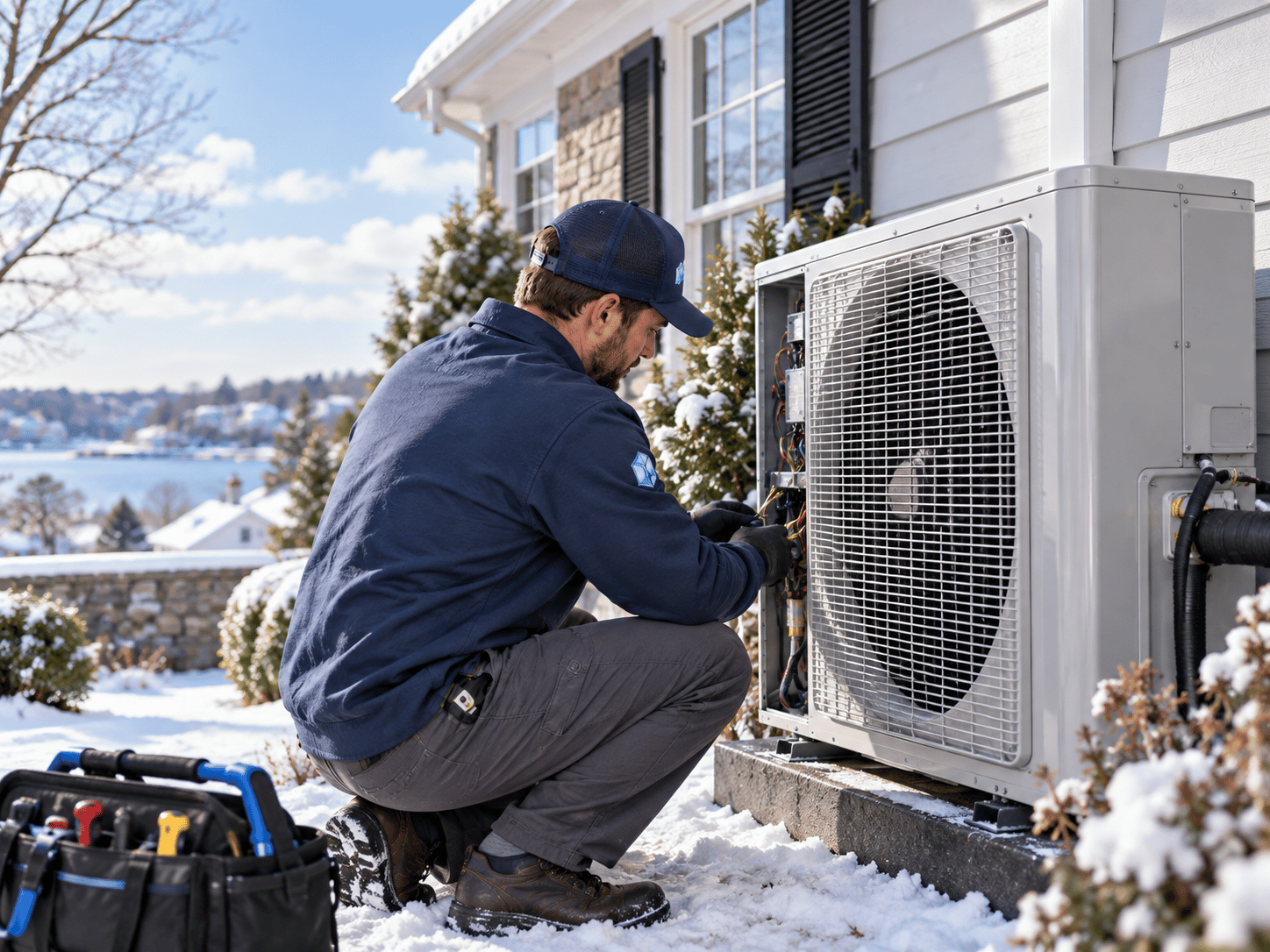
This is the question we get asked more than almost any other, and it usually comes with a story attached. Somebody's brother-in-law in Norwalk put one in and loves it. Somebody's neighbor in Trumbull put one in and says the house never felt warm in January. A homeowner in Westport read that heat pumps stop working below freezing. Another one in Greenwich read that they work down to fifteen below zero. Both of those readers found something on the internet that sounded authoritative.
So the honest answer is that heat pumps do work in Connecticut winters, and also that plenty of them have been installed badly enough that they did not. Those two things are not in conflict. The technology is real, the cold weather performance is measured and documented, and the failures we get called out to fix are almost never failures of the equipment concept. They are failures of sizing, of backup heat planning, of airflow, or of somebody selling a system that was never rated for our climate in the first place.
Cool As Ice has been working on heating and cooling in Fairfield County for more than 30 years. We install heat pumps. We also service oil boilers that are older than some of our technicians, and we have talked plenty of homeowners out of a heat pump when it was not the right call for their house. This article is meant to give you enough to judge the question for your own home rather than to sell you on an answer.
The Short Answer, and Why It Needs a Longer One
A properly selected cold climate heat pump will heat a Connecticut home through the winter. That is not a marketing claim. It is the entire basis of the federal certification standard that exists specifically to separate equipment built for our climate from equipment built for Georgia.
The longer answer is that "properly selected" is carrying a great deal of weight in that sentence. A heat pump is more sensitive to design and installation quality than a furnace is. A furnace that is 30 percent oversized is wasteful and cycles badly, but it will still make your house hot. A heat pump that is wrong for the load, wrong for the ductwork, or wrong for the outdoor temperatures it will face will leave you disappointed in a way that no amount of thermostat adjustment fixes.
That is why we spend more time on the assessment than on the sales pitch. The house tells us the answer.
CALL TO ACTION
If you are weighing a heat pump against repairing or replacing what you already have, we will look at your actual house before recommending anything. Book a 45-minute appointment, contact us, or call Rudy directly at (203) 515-1141.
What a Heat Pump Actually Does in Winter
A furnace or boiler makes heat. It burns fuel, and the chemical energy in that fuel becomes thermal energy in your house. The ceiling on that process is 100 percent, and no combustion appliance reaches it.
A heat pump does not make heat. It moves heat. Even air that feels brutally cold to you contains thermal energy, and a refrigeration cycle can collect that energy outdoors and release it indoors. Because the machine is transporting energy rather than creating it, the output can exceed the electrical input by a wide margin. The U.S. Department of Energy describes air-source heat pumps as able to "deliver up to three times more heat energy to a home than the electrical energy it consumes."
That ratio is the whole point, and it is also the source of the confusion. The ratio is not constant. It is highest on a mild day and lowest on the coldest night of the year, because the colder the outdoor air, the harder the machine has to work to pull usable heat out of it. Every honest conversation about heat pumps in Connecticut is really a conversation about what happens at the bottom of that curve.
What "Cold Climate" Means on Paper
Here is where the argument gets settled, because there is an actual published standard rather than a vibe.
ENERGY STAR maintains a cold climate designation for air-source heat pumps. To carry it, a unit has to demonstrate two things at 5 degrees Fahrenheit:
- A coefficient of performance at 5°F of at least 1.75, measured under the Appendix M1 H42 test.
- A heating capacity at 5°F of at least 70 percent of its capacity at 47°F.
ENERGY STAR also requires a controls verification procedure to confirm that the equipment's own native controls actually deliver those numbers during real operation in a home, rather than only on a test stand.
Translate that into plain language. A coefficient of performance of 1.75 means that when it is 5 degrees outside, the unit is still delivering 1.75 units of heat for every unit of electricity it draws. It is no longer three to one. It is still comfortably better than one to one, which is what electric baseboard gives you on its very best day. And the 70 percent capacity rule means the unit has not quietly shrunk to a third of its rated output right when you need it most, which is exactly what older heat pumps did and exactly why they earned their reputation.
Alongside that, ENERGY STAR's general efficiency thresholds for certified air-source heat pumps are at least 8.5 HSPF2 and 15.2 SEER2 for non-ducted split systems, and at least 8.1 HSPF2 and 15.2 SEER2 for ducted split systems and single package equipment.
Regionally, Northeast Energy Efficiency Partnerships maintains a cold climate air source heat pump specification and product list aimed at identifying equipment suited to IECC climate zone 4 and higher, which covers us. NEEP's ccASHP Specification Version 4.0 took effect January 1, 2023. Part of NEEP's stated reasoning for building the list at all is that the older HSPF metric "does not include low temperature testing points below 17°F" — in other words, the standard rating did not test the conditions Connecticut homeowners care about.
If a contractor cannot tell you whether the specific model they are quoting appears on a cold climate list, that is a meaningful gap in the conversation.
Why the Old Reputation Stuck
The skepticism is not irrational. It is just out of date.
Heat pumps sold in the 1980s and 1990s were single-stage machines. They ran at one speed, and their output fell off steeply as the temperature dropped. The standard design response was to bolt in electric resistance strip heat as backup, and that strip heat would engage far more often than anyone expected. Homeowners got lukewarm air, high electric bills, and a lasting impression.
The change since then is mostly about variable-capacity compressors and better refrigerant control. A modern inverter-driven unit can modulate its output across a range rather than slamming between full blast and off, which keeps efficiency up at part load and lets the machine keep producing meaningful capacity as it gets colder.
The U.S. Department of Energy ran a Residential Cold Climate Heat Pump Technology Challenge specifically to push this. DOE notes that cold climate heat pumps "operate with greater capacity and efficiency at outdoor temperatures below 32°F," and the program's committed manufacturer partners included Bosch, Carrier, Daikin, Johnson Controls, Lennox, Midea, Rheem, and Trane Technologies. Pacific Northwest National Laboratory published results from the Challenge's field validation, which ran from 2022 to 2024, in a report dated January 21, 2025.
That is a real federal program with real prototypes installed in real houses, not a brochure.
How Cold Does It Actually Get Here?
This matters more than people expect, and it is where a lot of internet arguments go wrong.
Fairfield County sits on Long Island Sound, and the water moderates our winters compared to inland Connecticut. A night in Norwalk or Darien is typically not a night in Litchfield County. But our towns are not uniform either. Ridgefield and Weston sit higher and further from the water than Greenwich or Westport, and they run colder. A house on an exposed ridge in Wilton faces a different reality than a shielded street in Stamford.
A proper load calculation does not guess at any of this. The industry standard is an ACCA Manual J load calculation, which uses a documented winter design temperature for your location rather than a technician's impression. Manual S then selects equipment against that load, and Manual D addresses the duct system. When we quote a heat pump, that is the chain of reasoning we are supposed to be able to show you.
Be careful of anyone who sizes a system off the square footage of the house or off the tonnage of whatever is sitting there now. The existing equipment may have been badly sized for forty years. Copying it forward just moves the mistake into a new box.
The Questions That Actually Decide It
When we walk a house in Fairfield or New Canaan and someone asks whether a heat pump will work, these are the things we are actually looking at:
- What are you heating with now, and what does it cost you? A heat pump replacing electric baseboard is a very different financial story than a heat pump replacing a well-maintained gas boiler.
- What is the envelope like? Insulation, windows, air sealing and attic condition drive the heating load. A leaky house needs more capacity at design conditions, which pushes the equipment harder at the worst moment.
- Is there ductwork, and is it any good? Existing ducts sized for a furnace may be undersized for the higher airflow a heat pump wants.
- What is the electrical service? Panel capacity and available circuits are a real constraint in older homes, and it is better to find that out during the estimate than during the install.
- Where can the outdoor unit go? It needs clearance, it needs to sit above expected snow depth, and it needs drainage for defrost water.
- What is your tolerance for the coldest ten nights of the year? Some people want the heat pump to carry everything. Others are perfectly happy to have a backup that picks up on the worst nights. Both are legitimate designs.
None of those questions can be answered from a phone call or a website form. That is not us being difficult. It is just the nature of the work.
Backup Heat and Hybrid Systems
There is a persistent idea that needing backup heat means the heat pump failed. It does not. It means somebody made a design choice.
Sizing equipment to carry 100 percent of the load on the single coldest hour of the year means the equipment is oversized for the other 99 percent of the winter, which costs money up front and hurts efficiency the rest of the season. Many good designs deliberately size the heat pump for the bulk of the heating season and pair it with a backup that engages on the extreme nights.
Those backups come in a few forms:
- Electric resistance strip heat. Simple, reliable, and expensive to run. Fine if it runs rarely. Painful if the controls are set so it runs constantly.
- A retained furnace or boiler. Often called a dual fuel or hybrid setup. The heat pump handles mild and moderate weather, the existing combustion equipment takes over when it gets very cold or when fuel prices favor it.
- Existing hydronic distribution kept in place. In a lot of older Fairfield County homes with cast iron radiators, keeping the boiler and adding ductless heat pumps for the spaces that need them is a more sensible path than ripping out a system that works.
That last option is one we suggest often, and it is worth saying plainly: if your boiler is in good shape, we are not going to tell you to throw it away. There is no version of our business model that requires that.
CALL TO ACTION
A hybrid setup that keeps your existing boiler is frequently the better answer in an older home, and we will tell you if that is the case for yours. Book a 45-minute appointment, contact us, or call Rudy directly at (203) 515-1141.
Running Costs Compared to What You Have
The most useful data point we can give you here comes from the Department of Energy, which cites a Northeast study of air-source heat pump savings. Against electric resistance heaters, the reported annual savings were around 3,000 kWh, or $459. Against oil systems, the reported figure was 6,200 kWh, or $948.
Those are study figures from a specific set of homes, not a promise about your house. Your actual result depends on your electric rate, your fuel price, your envelope, your thermostat habits, and how the system is configured. We would rather hand you a sourced number with that caveat attached than invent a savings estimate that sounds better.
What the direction tells you is real enough. Electric resistance heat is the most expensive common way to heat a home in Connecticut, and replacing it with a heat pump is close to a sure win. Oil is the next most likely to benefit. Natural gas is the hardest case to justify on running cost alone, which is why we do not push heat pumps at homeowners with healthy gas boilers.
For context on how much that varies locally: U.S. Census Bureau American Community Survey data for 2024 found that 36 percent of Connecticut households heat with utility gas, 35 percent with heating oil, and 20 percent primarily with electricity. Fairfield County is a genuine mix of all three, sometimes street by street, because gas main coverage in towns like Norwalk, Stamford and Fairfield is uneven and often stops well short of the outlying neighborhoods.
Sizing, Airflow, and Why Installation Quality Decides the Outcome
If you remember one thing from this article, make it this: almost every disappointed heat pump owner we meet has an installation problem, not a technology problem.
Airflow is the most common one on ducted systems. The Department of Energy's guidance for air-source heat pumps calls for roughly 400 to 500 cubic feet per minute of airflow per ton, and notes that "efficiency and performance deteriorate if airflow is much less than 350 cfm per ton." Older ductwork in a 1950s Cape in Trumbull or a 1920s colonial in Westport was frequently sized for a system with very different requirements. Drop a modern heat pump onto undersized ducts and it will underperform its ratings no matter how good the equipment is.
The other repeat offenders we find:
- Refrigerant charge set by guesswork rather than by measurement.
- Line sets that are too long, too restrictive, or poorly insulated.
- Outdoor units set too low to the ground, so they sit in snow and slush during defrost cycles.
- Thermostat and control settings that call in backup strip heat far more aggressively than necessary.
- Leaky return ducts pulling cold attic or crawlspace air into the system.
That last one connects to something ENERGY STAR documents about duct systems generally: roughly 20 to 30 percent of the air moving through a typical home's ducts is lost to "leaks, holes, and poorly connected ducts." Putting high-efficiency equipment on a duct system with that kind of loss is a poor use of your money, and it is one of the first things we look at during HVAC maintenance or an equipment assessment.
Ducted, Ductless, or Both
Heat pumps come in more shapes than people realize, and the right shape depends on the house.
- Ducted central heat pumps make sense where there is existing forced-air ductwork in reasonable condition, or where a renovation makes new duct runs practical.
- Ductless mini-splits mount on the wall or ceiling and connect to the outdoor unit through a small penetration. The Department of Energy notes that ductless systems "require minimal construction as only a three-inch hole through the wall is required." These are the usual answer for older Fairfield County homes that never had ducts.
- Short-run ducted systems use a compact duct section serving a few rooms, which can be a good compromise in a finished attic or a bedroom wing.
- Hybrid arrangements combine a heat pump with retained combustion heat, as described above.
We handle all of these under heating systems and cooling systems, and worth noting: a heat pump is your air conditioning too. If you are replacing an aging AC condenser anyway, the incremental conversation about heating capability is a much shorter one.
Incentives in Connecticut Right Now
Be careful with incentive information, because it changes and a lot of what is online is stale.
Two things are worth knowing as of this writing.
First, the federal Energy Efficient Home Improvement Credit under Section 25C is no longer available. ENERGY STAR's own guidance describes those credits as available "through December 31, 2025." If a contractor is still quoting you a federal tax credit on a heat pump, ask them to show you the current authority for it.
Second, state and utility incentives do still exist. Energize Connecticut — an initiative of the Connecticut Energy Efficiency Fund, the Connecticut Green Bank, the State, and local utilities — lists a residential air source heat pump incentive of $250 per ton up to $2,500 in combined incentives for qualifying equipment, valid January 1 through December 31, 2026. Eligibility requires being a residential electric customer of Eversource or United Illuminating, installation by a participating contractor from the Energize CT Heat Pump Installer Network, and equipment listed on the Energize CT Heat Pump Qualified Product List. Energize Connecticut also lists enhanced incentives of $1,500 per ton for eligible installations completed after April 1, 2026 for households replacing electric resistance heating or meeting income-based criteria between 60 and 80 percent of Area Median Income.
Program terms change annually, and different rebate tracks apply depending on what you are replacing. Verify current figures with Energize Connecticut directly before you count on any number, including the ones above.
When We Tell People Not to Do It
We would rather lose a sale than install something that will make a customer unhappy for the next fifteen years. Situations where we routinely advise against a heat pump conversion:
- A healthy, well-maintained gas boiler or furnace with years of life left. Age alone does not determine the answer. A 16-year-old system in good condition with a clean service history is not a replacement candidate just because it hit a number.
- An electrical service that cannot support the system without a major upgrade, where that upgrade cost swamps any operating savings.
- A house with serious envelope problems where insulation and air sealing would deliver far more comfort per dollar than new equipment. We will say this out loud even though insulation is not what we sell.
- A homeowner planning to sell within a couple of years, where the payback period simply will not land.
- A duct system in poor enough shape that it needs to be addressed first regardless of what equipment goes on the end of it.
If you have been told by someone that your only option is full replacement, a second opinion costs you very little. Our service and repair team fixes far more equipment than we replace, and that is by design.
A Safety Note
This article is about heat pumps, but most Fairfield County homes still have combustion equipment somewhere in them, so this needs saying.
If you smell gas, do not investigate it. Leave the building, take everyone with you, and call your gas utility's emergency line or 911 from outside. Do not flip switches, do not use the phone inside, and do not try to find the source.
If a carbon monoxide alarm sounds, treat it as real. The U.S. Consumer Product Safety Commission's guidance is direct: "If you suspect CO poisoning, get outside to fresh air immediately, and then call 911." Have the equipment inspected by a qualified technician only after the immediate emergency has been handled by the appropriate authorities. A CO alarm is not a device you troubleshoot.
For heating failures that are urgent but not a safety emergency, we offer emergency HVAC service around the clock.
How We Handle the Conversation
When someone in Norwalk, Stamford, Greenwich, Darien, New Canaan, Westport, Fairfield, Wilton, Weston, Ridgefield or Trumbull calls us about a heat pump, the first visit is an assessment, not a pitch. We look at the existing equipment, the distribution system, the envelope, the electrical service, and the spots in the house that never feel right. We also serve parts of Westchester County in New York, including Rye, Armonk, Bedford and Pound Ridge, where the housing stock raises many of the same questions.
Then we give you the options, including the option of keeping what you have. Sometimes the right answer is a full conversion. Sometimes it is two ductless heads to fix the rooms that have always been miserable while the boiler keeps doing its job. Sometimes it is a tune-up and a duct repair and a conversation again in three years.
Cool As Ice is family-owned, and we have been doing this locally for more than 30 years. That only works if people call us back. You can read more about our company, check our service areas, or look through our frequently asked questions.
CALL TO ACTION
Ready to find out whether a heat pump makes sense for your house, or whether it does not? We will give you a straight answer either way. Book a 45-minute appointment, contact us, or call Rudy directly at (203) 515-1141.
Frequently Asked Questions
At what temperature does a heat pump stop working?
There is no single temperature, and the answer depends entirely on the model. What is standardized is the testing. ENERGY STAR's cold climate designation requires a coefficient of performance of at least 1.75 at 5°F and heating capacity at 5°F of at least 70 percent of capacity at 47°F. Ask which specific model is being quoted and what its published low-temperature performance is, rather than accepting a general claim.
Will I still need my oil boiler or gas furnace?
Not necessarily, but keeping it is often a good idea. Hybrid designs that retain existing combustion equipment as backup are common in Fairfield County and let you use whichever heat source makes sense on a given day. In homes with cast iron radiators and no ductwork, keeping the boiler and adding ductless heads is frequently the most practical route.
Is a heat pump cheaper to run than oil?
Department of Energy figures from a Northeast study report annual savings of 6,200 kWh, or $948, for air-source heat pumps compared with oil systems, and around 3,000 kWh or $459 compared with electric resistance heat. Your result will differ based on electric rates, fuel prices, your home's insulation and how the system is set up. We can walk through your actual numbers during an assessment.
Do heat pumps work in homes without ductwork?
Yes. Ductless mini-splits are designed for exactly that situation, and the Department of Energy notes they require minimal construction because only a three-inch hole through the wall is needed. This is the most common heat pump application in older Connecticut homes with radiators or baseboard heat.
Why do some people say heat pumps left them cold?
Usually one of a handful of installation issues: undersized equipment, ductwork that cannot move enough air, incorrect refrigerant charge, controls calling backup strip heat too aggressively, or equipment that was never rated for cold climate use to begin with. The Department of Energy calls for roughly 400 to 500 cfm per ton of airflow and notes performance deteriorates below 350 cfm per ton, and a lot of older duct systems simply cannot deliver that.
Are there still rebates available in Connecticut?
Energize Connecticut lists a residential air source heat pump incentive of $250 per ton up to $2,500 in combined incentives for qualifying equipment for 2026, with enhanced incentives of $1,500 per ton for certain eligible households after April 1, 2026. Requirements include being an Eversource or United Illuminating electric customer and using a participating installer with qualified equipment. The federal Section 25C tax credit is no longer available, having been listed by ENERGY STAR as running through December 31, 2025. Always confirm current program terms directly.
Does a heat pump replace my air conditioning too?
Yes. A heat pump provides cooling in summer using the same equipment, which is one reason the economics look better if your existing AC is near the end of its life anyway. We cover this under residential HVAC.
My heat pump is running constantly. Is something wrong?
Not necessarily. Modern variable-capacity heat pumps are designed to run long, low-output cycles rather than short bursts, and steady operation is often a sign the system is working as intended. What matters is whether the house is holding temperature comfortably. If it is not, or if the behavior changed suddenly, have it looked at.
About Cool As Ice HVAC
Cool As Ice HVAC is a family-owned heating and cooling company based in Norwalk, Connecticut, with more than 30 years of local experience.
- Office: (203) 515-7693
- Rudy Jimenez, head mechanic, direct: (203) 515-1141
- Hours: Monday through Friday 7am to 6pm, Saturday 8am to 4pm, with emergency service available 24/7
- Service area: Fairfield County, including Norwalk, Stamford, Greenwich, Darien, New Canaan, Westport, Fairfield, Wilton, Weston, Ridgefield and Trumbull, plus select Westchester County, New York communities including Rye, Armonk, Bedford and Pound Ridge
We handle residential HVAC, commercial HVAC, and hot water systems throughout the region. Experienced service. Family-owned care. Comfort you can count on.