
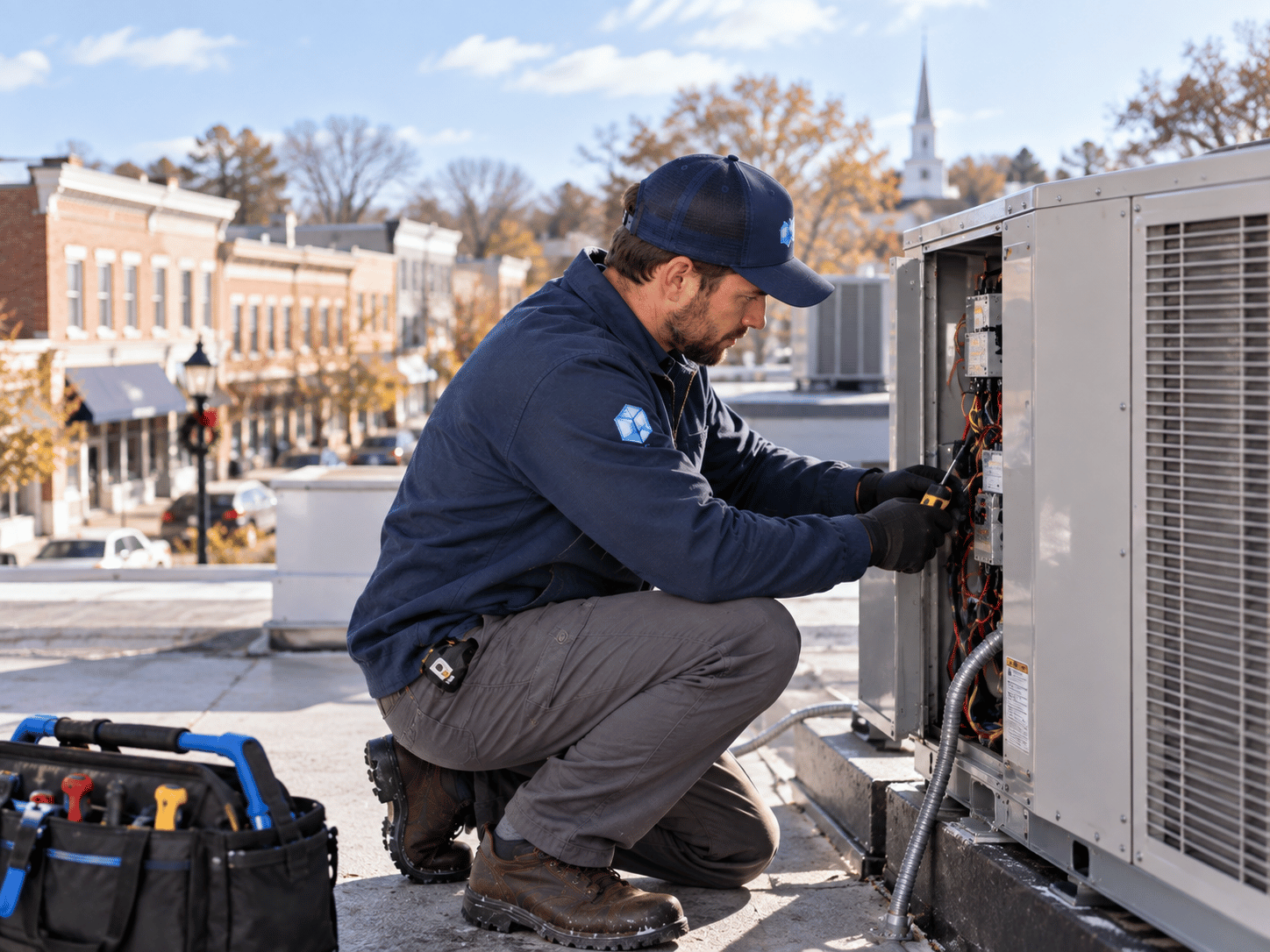
Nobody opens a restaurant in Norwalk because they are passionate about rooftop units. Nobody signs a lease on a retail space in Westport thinking carefully about where the condenser sits. You are thinking about the business. The HVAC is just supposed to work.
Then it is 94 degrees in July, the dining room is unbearable, and you are calling whoever answers the phone.
We have been doing commercial HVAC work in Fairfield County for more than 30 years, and the pattern is consistent. Small business owners are not careless about their equipment. They are busy. Heating and cooling stays invisible until the day it becomes the only thing that matters, and by then the options are worse and more expensive than they would have been.
This article is about the middle ground: what small commercial HVAC actually involves, what tends to go wrong in the kinds of buildings we work in around here, and what is genuinely worth spending money on versus what is being sold to you.
Small Commercial Is Its Own Category
There is a tendency to treat commercial HVAC as one thing. It is not. A hospital, a 300,000 square foot office tower, and a 2,200 square foot dental office in Darien have almost nothing in common mechanically.
Small commercial is its own world, and it is the world most Fairfield County businesses live in. According to ENERGY STAR, properties under 50,000 square feet make up more than 90 percent of the commercial building stock in the United States. That is the overwhelming majority of commercial buildings, and they typically do not have a facilities department, a building engineer, or a maintenance budget line item.
What they have instead is an owner who notices when something is wrong, and a phone.
That shapes everything about how this work should be done. You need a contractor who will explain things plainly, who will tell you when something can wait, and who understands that a two-day shutdown is not a scheduling inconvenience for you, it is lost revenue.
What the Numbers Actually Say About Commercial Energy
A few figures worth knowing, with sources, because most of what gets quoted in commercial HVAC sales material is unsourced.
- ENERGY STAR reports that the average commercial building wastes 30 percent of the energy it consumes. Not uses inefficiently. Wastes.
- ENERGY STAR also states that by implementing low- or no-cost measures, owners and managers can reduce the energy consumption of their buildings by up to 30 percent. Note the phrase low- or no-cost. This is not a pitch for new equipment.
- According to the U.S. Energy Information Administration's 2018 Commercial Buildings Energy Consumption Survey, nearly one-third of the energy consumed in commercial buildings in 2018 went to space heating, at 2.2 of 6.8 total quads.
- ENERGY STAR states that on average, ENERGY STAR certified buildings use 35 percent less energy than typical buildings nationwide.
- ENERGY STAR also notes that buildings are responsible for 18 percent of U.S. greenhouse gas emissions.
The number we find most useful for small business owners is the first two together. A meaningful share of what a typical commercial building spends on energy is waste, and a meaningful share of that waste can be addressed without buying anything. That is the opposite of what you usually hear from someone trying to sell you a system.
CALL TO ACTION
Running a business in Fairfield County and not sure what condition your HVAC is actually in? We will come look at it and tell you straight, including if the answer is that it is fine. Call Rudy directly at (203) 515-1141 or contact us to schedule an appointment.
What You Probably Have on Your Building
Small commercial spaces in this area tend to run on a handful of equipment types. Knowing which one you have makes every conversation with a contractor easier.
- Rooftop units, usually called RTUs or packaged units. The most common setup for strip retail, small offices, and restaurants. Everything, compressor, coils, blower, and often a gas heating section, lives in one cabinet on the roof, with ductwork dropping into the space.
- Split systems. An outdoor condenser plus an indoor air handler or furnace, the same basic arrangement as a house, sized up. Common in converted buildings and smaller storefronts.
- Ductless mini-splits and multi-splits. Increasingly common in older Fairfield County buildings where running ductwork is impractical, and in spaces that were carved up into separate suites.
- Hydronic systems with boilers. Very common in older commercial buildings in Norwalk, Stamford, and Greenwich, sometimes serving radiators, sometimes fan coils.
- Unit heaters and infrared heaters. Typical in warehouse, shop, and garage space.
- Make-up air units and exhaust systems. Essential in restaurants and any space with a commercial kitchen hood, and one of the most commonly neglected pieces of equipment we encounter.
Many buildings have more than one of these, sometimes installed decades apart by different contractors with different ideas. That patchwork is normal, and part of our job is understanding how the pieces actually interact.
The Problems We See Most Often in Small Fairfield County Commercial Buildings
Rooftop units that nobody has been on the roof to look at. This is by far the most common. An RTU sits outside in the weather all year. Coils load up with debris, belts wear, bearings dry out, drain pans clog, cabinet panels loosen, and economizer dampers seize. None of that is visible from inside the building. The first sign is often a complete failure on the hottest day of the year.
Deferred maintenance that compounds. A dirty condenser coil makes the compressor work harder. A compressor working harder draws more current and runs hotter. A compressor running hot for two summers is a compressor that fails in the third. Each step is small. The endpoint is a major expense.
One thermostat trying to control a space that needs three. A storefront with a sunny south-facing window, a back office, and a storage area has genuinely different loads in each zone. A single thermostat in one of those areas will keep the other two uncomfortable no matter what setting it is on.
Equipment inherited from a previous tenant and never re-evaluated. A space that was a clothing boutique and is now a coffee shop has a fundamentally different load. Espresso machines, ovens, refrigeration, and more people in a smaller footprint all change the equation. The equipment that served the boutique adequately may be badly undersized now, or the ventilation may no longer be appropriate for the use.
No documentation of anything. No model numbers, no service history, no record of what was replaced when, no idea how old the equipment is. This makes every diagnosis slower and every decision harder.
Ambiguity about who is responsible. More on this below, because it is worth its own section.
Ventilation and exhaust treated as optional. Particularly in restaurants, where an exhaust hood without properly functioning make-up air will pull conditioned air out of the space, create negative pressure, and in some configurations cause real problems with combustion appliances.
The Lease Question: Who Actually Owns This Problem
If you lease your space, this is the single most important thing to nail down, ideally before you need it.
Commercial leases vary enormously in how they handle HVAC. In our experience, the arrangements generally fall into a few patterns:
- The landlord is responsible for the equipment entirely, including repair and replacement.
- The tenant is responsible for routine maintenance and repairs up to a dollar threshold, with the landlord responsible above that or for replacement.
- The tenant is responsible for everything, including replacement, which is common in triple-net arrangements.
- The lease is genuinely ambiguous, which is more common than it should be.
We are an HVAC company, not your attorney, and we cannot interpret your lease for you. What we can tell you is what we see happen: a business owner discovers on the day a compressor fails that they are responsible for a replacement they had no reason to expect. That is a bad day to find out.
Read the HVAC clause now. If it is unclear, get clarity in writing. If you are responsible for maintenance, start doing it, because in many leases failing to maintain the equipment shifts responsibility for the resulting failure onto you regardless of what the replacement clause says.
If you are a landlord with small commercial tenants in Norwalk, Stamford, Fairfield, or Trumbull, the same logic runs the other direction. Equipment that is maintained lasts longer and creates fewer tenant disputes.
What Different Kinds of Businesses Actually Need
The right approach varies a lot by use. A few patterns we see across Fairfield County:
- Restaurants and food service. The most demanding small commercial category, by a wide margin. Kitchen exhaust, make-up air, dining room comfort, and refrigeration heat rejection all interact. Negative pressure from an exhaust system without adequate make-up air causes doors that are hard to open, drafts, and combustion problems. Get the air balance right and everything else gets easier.
- Retail. Customer comfort near the entrance matters disproportionately, and entry doors opening repeatedly in January or July create a load nothing in a residential context prepares you for. Vestibules and air curtains are worth discussing.
- Offices and professional services. Usually the most straightforward, but frequently zoned badly, with conference rooms that are freezing when empty and stifling when full.
- Medical, dental, and veterinary. Ventilation requirements, humidity control, and equipment heat loads are all elevated, and reliability expectations are higher because you cannot reschedule a day of patients easily.
- Salons and barbershops. Chemical exhaust and ventilation matter more than most owners realize, and comfort expectations are high because clients are sitting still for an hour.
- Gyms and fitness studios. High occupant loads, high ventilation needs, and significant humidity generation. Undersized and under-ventilated is the common condition.
- Warehouse and light industrial. Often the question is less about comfort and more about freeze protection, spot heating, and ventilation, which calls for entirely different equipment than an office.
- Churches, community spaces, and nonprofits. Intermittent, very high occupancy in a space that sits empty most of the week. Scheduling and controls matter as much as equipment.
- Daycare and educational spaces. Ventilation and consistent comfort, with low tolerance for outages.
Whatever category you are in, our commercial HVAC work starts with understanding how the space is used, not with pricing equipment.
CALL TO ACTION
Restaurant, retail, office, or shop, if your space has comfort problems you have learned to live with, they usually have a cause that can be found. Let us take a look. Call Rudy directly at (203) 515-1141 or contact us to schedule an appointment.
What a Commercial Maintenance Agreement Should Actually Include
Maintenance agreements are where a lot of small businesses either get good value or get sold something thin. Here is how to tell the difference.
A worthwhile agreement should include:
- A defined number of scheduled visits per year, appropriate to your equipment and how hard it works
- An actual written scope of what gets inspected and serviced on each visit, not just the word maintenance
- Filter changes, with the filter type and frequency specified
- Coil cleaning, condenser and evaporator, on a stated schedule
- Belt and motor inspection where applicable
- Electrical inspection, including contactors, capacitors, and connections
- Refrigerant system checks appropriate to the equipment
- Condensate drain cleaning and inspection, which prevents a very common and very damaging failure
- Combustion and venting checks on any gas-fired equipment, before the heating season
- A written report after each visit that you keep
- Clear terms on how repairs are priced and how emergencies are handled
Things to be skeptical of:
- Agreements with no written scope of work
- Pressure to sign a multi-year agreement on a first visit
- Automatic renewal terms you cannot easily exit
- A maintenance visit that produces a replacement recommendation but no actual service performed
- Vague promises of savings percentages with no basis
That last one matters. If somebody tells you a maintenance plan will cut your energy bill by a specific percentage, ask where the number comes from. Maintenance genuinely helps equipment run as designed and catches problems early. Those are real benefits. A precise savings guarantee for your specific building, offered before anyone has looked at your building, is marketing.
Our approach to HVAC maintenance is to document what we find and hand you the report, so you have a record that belongs to you whether or not you keep working with us.
Planning for the Failure That Will Eventually Happen
Every piece of equipment fails eventually. The difference between a manageable failure and a business-disrupting one is almost entirely preparation.
Things worth doing before you need them:
- Document your equipment. Photograph the data plate on every unit. Model number, serial number, manufacture date. Keep it somewhere you can reach from your phone.
- Know your equipment's age. It changes the calculus on every repair decision.
- Know who to call and have the number saved. Not a search result at 6am. A number.
- Understand your after-hours situation. If your business runs on weekends and evenings, confirm before you need it that your contractor covers those hours.
- Know your lease obligations. Covered above, and it comes up at the worst moment.
- Have a contingency. For some businesses this means temporary cooling, for others it means knowing you will close. Either way, decide in advance.
Cool As Ice provides emergency HVAC service 24 hours a day, seven days a week, because commercial failures do not respect business hours. But the best emergency call is the one that never happens because the problem got caught in October.
Repair or Replace: How the Math Is Different for a Business
For a homeowner, the repair-versus-replace decision is mostly about the cost of the repair against the remaining life of the equipment. For a business, there is a third variable that often dominates: downtime.
A repair that keeps a restaurant open through the weekend may be worth doing even if replacement is coming in six months. A replacement scheduled during your slow season may be worth doing even if the current equipment could limp along, because you control the timing instead of the equipment controlling it.
Factors we walk through with commercial customers:
- Age and condition of the equipment, and whether parts are still readily available
- Repair history, especially repeated failures of the same component
- How critical the equipment is to your operation staying open
- Whether the equipment was correctly sized for the current use of the space
- Your lease term and responsibility, since replacing equipment in a space you are leaving in eighteen months is a different decision
- Whether a planned replacement during a slow period is available as an option
- Current operating cost versus what better equipment would realistically do
What we will not do is tell you a unit needs to be replaced because it has reached a certain age. Age is one input. We have seen well-maintained equipment run reliably well past its nominal life and neglected equipment fail early. The condition of the specific machine matters more than the number on the data plate.
Our service and repair work and our replacement work are the same business, which means we have no structural reason to steer you toward one. If the repair is sensible, we will tell you the repair is sensible.
Ventilation and Air Quality in Commercial Spaces
Commercial ventilation is a genuinely different subject from residential, because occupant density is higher and the building code treats it accordingly.
Things worth understanding:
- Most commercial HVAC equipment has a provision for outdoor air, often through an economizer on rooftop units. When that mechanism seizes or is disabled, you lose ventilation without any obvious symptom.
- Economizers can also save real money by using cool outside air instead of running the compressor in mild weather, and a stuck economizer gives that up silently.
- Filtration in commercial equipment is frequently the cheapest available filter, changed rarely. Better filtration is often possible but has to be matched to what the equipment can handle without choking airflow.
- Exhaust and make-up air have to be considered together. Exhausting air without replacing it creates negative pressure with real consequences.
- Humidity control matters in some spaces far more than temperature, particularly gyms, restaurants, and any space with a lot of people.
If your space feels stuffy even when the temperature is right, ventilation is usually the place to look, and it is frequently fixable without new equipment.
What We Will Not Do
We think it is worth being explicit about this, because small business owners get pitched constantly.
We will not recommend replacing functioning equipment because it is old. We will not quote a savings percentage we cannot source. We will not sell you a maintenance agreement without a written scope. We will not tell you an indoor air quality product will solve a comfort problem that is actually an airflow problem. And we will not pressure you to decide something during a service call.
We are family-owned. Rudy, our head mechanic, is on job sites, and he is reachable directly. That is not a marketing arrangement, it is just how a small company works, and we think it suits working with other small businesses.
CALL TO ACTION
Whether you need a second opinion on a quote, a maintenance plan that actually says what it covers, or someone to finally get on the roof and look at that rooftop unit, we are glad to help. Call Rudy directly at (203) 515-1141 or contact us to schedule an appointment.
Frequently Asked Questions
How often should commercial HVAC equipment be serviced?
It depends on the equipment and how hard it works, but most small commercial systems benefit from at least two visits a year, one before cooling season and one before heating season. Restaurants, gyms, and other high-demand spaces often need more. Equipment that runs longer hours and in dirtier conditions needs more attention than an office system.
Who is responsible for HVAC in a commercial lease, the landlord or the tenant?
That depends entirely on your lease, and the arrangements vary widely. Some leases put everything on the landlord, some put maintenance on the tenant and replacement on the landlord, and triple-net leases often put everything on the tenant. Read the HVAC clause before you need it. We cannot interpret your lease, but we can tell you that finding out on the day of a failure is the worst way to learn.
Is a maintenance agreement actually worth it for a small business?
It can be, if it has a real written scope of work and is appropriate to your equipment. The value is in catching problems early and keeping equipment running as designed, which matters more when downtime costs you revenue. Be skeptical of agreements with no written scope, long lock-in terms, or specific savings guarantees offered before anyone has seen your building.
What is a rooftop unit and why does mine keep having problems?
A rooftop unit, or RTU, is a packaged system containing the compressor, coils, blower, and usually a heating section in one cabinet on your roof. They have problems disproportionately because they sit exposed to weather year-round and almost nobody goes up to look at them. Coil fouling, belt wear, clogged condensate drains, and seized economizer dampers are all common and all preventable.
My restaurant is always drafty and the doors are hard to open. Is that an HVAC problem?
Very likely yes, and specifically an air balance problem. If your kitchen exhaust is pulling more air out of the building than make-up air is bringing in, the space goes negative, which produces exactly those symptoms. It is also a combustion safety concern in some configurations. This is worth having evaluated.
Do I need to replace my system if it is more than 15 years old?
Not automatically. Age is one factor among several, including condition, repair history, parts availability, whether it is correctly sized for how you use the space now, and your lease situation. We have seen maintained equipment run well past its nominal life. We would rather evaluate the specific machine than make a recommendation based on a number.
Can you work outside business hours so we do not have to close?
In many cases yes, and for commercial customers we plan around your operation whenever the work allows it. Our regular hours are Monday through Friday 7am to 6pm and Saturday 8am to 4pm, with emergency service available 24 hours a day, seven days a week. Tell us your constraints when you call and we will work with them.
My space was a different kind of business before. Does that matter?
It matters a lot. Equipment sized for a retail shop may be badly undersized for a restaurant or a gym, and ventilation requirements differ by use. If you took over a space and inherited the previous tenant's system, having it evaluated against how you actually use the space is one of the more worthwhile things you can do.
About Cool As Ice HVAC
Cool As Ice HVAC is a family-owned heating and cooling company based in Norwalk, Connecticut, with more than 30 years of experience serving local businesses and homeowners.
- Office: (203) 515-7693
- Rudy Jimenez, head mechanic, direct: (203) 515-1141
- Hours: Monday through Friday, 7am to 6pm; Saturday, 8am to 4pm; emergency service available 24/7
- Service area in Fairfield County, CT: Norwalk, Stamford, Greenwich, Darien, New Canaan, Westport, Fairfield, Wilton, Weston, Ridgefield, and Trumbull
- Select Westchester County, NY communities: Rye, Armonk, Bedford, and Pound Ridge
Alongside commercial work we handle residential HVAC, heating systems, cooling systems, and hot water systems. See our full service areas, browse our FAQs, or learn more about our family business.
Sources referenced in this article: ENERGY STAR, Small and Medium-Sized Office Buildings resources and Commercial Buildings Facts and Stats; U.S. Energy Information Administration, 2018 Commercial Buildings Energy Consumption Survey (CBECS).